












Best Smart Scale - Withings Cardio, QardioBase, Xiaomi Mi Body Scale
By Sander SaarPublished Updated Length
Loading YouTube player.
Best Smart Scale - Withings Cardio, QardioBase, Xiaomi Mi Body Scale
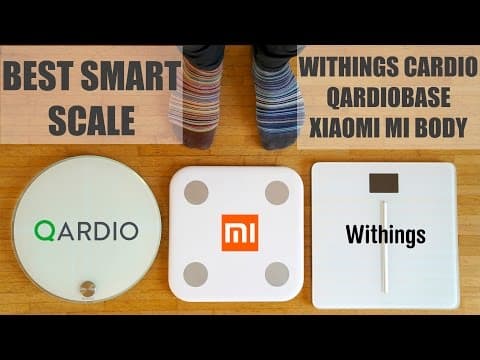
Sander Saar compares three smart scales: the Withings Cardio, the QardioBase, and the Xiaomi Mi Body Scale, evaluating them on user experience, measurements and accuracy, and app integration. He examines their physical design, including dimensions, thickness, stability, battery types, LED displays, measurement speeds, and retail prices. The video outlines the body composition metrics tracked by each device and presents results from a three-day consistency test, showing that the Xiaomi and Withings scales are most consistent for weight, while the Xiaomi scale has the lowest variability for body composition. He also compares Wi-Fi and Bluetooth syncing, reviews the iOS and Android companion apps alongside Apple HealthKit and Google Fit integration, and notes interface issues on the Withings and QardioBase apps. Concluding that consistency is more important than scientific precision, Sander recommends the Xiaomi Mi Body Scale as the best value option.
Watch on AgentTVAsk about this video
Chapter summaries
Why smart scales matter and the three contenders
Sander introduces the benefits of quantifying yourself and explains why he selected the Withings Cardio, QardioBase, and Xiaomi Mi Body Scale over other brands. He outlines his three evaluation criteria: user experience, measurements and accuracy, and app integration.
On screenA man in a light grey t-shirt sits on a grey sofa against a plain white wall, speaking and gesturing to the camera. Behind him on the sofa back are three white smart scales: a rectangular Withings scale, a round glass Qardio scale, and a square Xiaomi scale with four circular pads. Animated title graphics, a vintage brass spring balance inset, scale logos, and a numbered list of review criteria appear on screen.
Size, design, screens, and price compared
A comparison of the physical appearance and usability of the three scales, covering dimensions, thickness, battery types, stability, embedded LED displays, measurement speed, electrode design, and retail prices.
Testing accuracy and consistency across body metrics
An overview of the body composition metrics each scale tracks, followed by a three-day consistency test. Xiaomi and Withings are most consistent for weight, while Xiaomi shows the lowest variability for body composition, and Wi-Fi versus Bluetooth syncing is compared.
On screenA man in a light grey short-sleeved t-shirt sits on a grey fabric couch against a plain white wall indoors, speaking to camera and gesturing with his hands. Behind him on the couch back are three white smart scales: a rectangular scale with a black display and vertical silver strip on the left, a round frosted glass scale in the centre, and a square scale with four grey circular pads on the right. The video cuts to top-down views on a light wooden floor, first showing all three scales lined up beneath white text listing Weight, Body Mass Index (BMI), Fat Mass, Muscle mass, Water mass, and Bone Mass, with QARDIO visible. Closer top-down shots show the rectangular Withings scale with overlaid text for Heart Rate and Pulse Wave Velocity, followed by the square Xiaomi scale with text for Visceral Fat Level, Basal Metabolism, and Body Score. An overhead shot shows feet in mismatched striped socks standing on a white smart scale on a wooden floor, with its small illuminated display showing measurements in light blue, including 74.8 kg and Body (%). Returning to the man on the couch, overlaid bar charts with blue, green, and red bars compare the Xiaomi Mi Body Scale, QardioBase, and Withings Cardio across Weight in the upper right, then Water Mass % and Fat Mass % in the upper left. Towards the end, two black Wi-Fi icons appear in the upper left and a blue Bluetooth icon appears in the upper right while the man continues speaking and gesturing with the three scales behind him.
Comparing the iOS and Android companion apps
A look at how the three scales integrate with Apple HealthKit and Google Fit, alongside a walkthrough of each brand's iOS and Android app. Xiaomi's app is praised for its clarity, while Withings and QardioBase are critiqued for interface glitches and limited metric explanations.
On screenAfter a brief shot of the presenter on the grey sofa, close-up shots show two hands holding an iPhone and an Android phone side by side, marked with Apple and Android logos. Fingers tap and scroll through Apple HealthKit, Google Fit, and the companion apps for Xiaomi, Withings, and QardioBase, displaying weight trends, body composition figures, and line graphs.
Final verdict and best value recommendation
Sander concludes that consistency is more important than scientific precision and recommends the Xiaomi Mi Body Scale as the best value, noting it costs a fraction of the Withings Cardio and QardioBase. He reminds viewers that scales only support regular exercise and signs off.
On screenThe presenter sits on the grey sofa in front of the plain white wall with the three white smart scales propped behind him. He speaks and gestures expressively, gives a thumbs up, and waves goodbye before the video transitions to animated end cards on a blue textured background and fades to black.
Transcript
Hi everybody, I'm Sander and I believe in technology. Today we're gonna take a look at smart scales in order to help you and myself get into a better shape. So let's take a closer look. The benefits of quantifying oneself are clear. They help to motivate us, give us visibility, and understand how well we're progressing towards our goals. And scales are probably one of the oldest methods of doing so, dating back to the 18th century.
Scales have evolved a lot over time to do much more than just show you your weight. So you can be really precise in setting your goals rather than just saying, I want to gain weight or want to lose weight. You can now set goals by changing your body composition, for example, to lose more fat and gain more muscle. There are a lot of smart scales out there, all the way from the Chinese manufacturers to the kind of Western flagships, and I've used many of them before.
For example, I didn't like Fitbit Aria for the reason that they're building a closed ecosystem, so it doesn't integrate with Apple HealthKit or Google Fit, for example. I didn't like Garmin because it had a really poor app experience, but these 3 are really my top. In this video, I've selected 3 smart scales that I've used longest and I think are one of the most advanced ones out there. First of all, the Withings cardio scale, the Cardio Base, as well as the Xiaomi Mi Body Scale that recently was updated.
There are 3 things that are important to me when selecting a scale. First of all, the overall user experience, usability, and the aesthetics of the physical appearance of the scale. Second thing is the measurements, the accuracy and consistency. And the third thing is integration and the app ecosystem. First of all, let's take a look at the usability and the physical appearance of the scales. Withings cardio scale is definitely the largest in the mix, especially when you put them side by side.
It's 12.8 inches on the side or 32.5 centimeters, while Cardio Base is circular at similar diameter. The Xiaomi Mi Body Scale is the smallest at 11.7 inches or 30 centimeters. Xiaomi is also the thinnest at 0.6 inch, followed by Withings at 0.7 and almost 0.9 inches for the Cardiyo. While Xiaomi is powered by 4 AAA batteries, Cardiyo Base is powered by 8 AAA batteries.
That's a lot of batteries and they run out relatively quickly. Withings has taken a more sustainable approach by including a rechargeable USB battery pack which they say you only need to charge once a year. Withings and Xiaomi are both very flat and very close to the floor, and they're super stable as they're square as well. While on the other hand, with Cardiobase, I've actually slipped quite a few times because it's so unstable to step on it. Looking at the screens, Xiaomi and Cardiobase have super nice discreet embedded LED screens, while the one on Cardiobase is harder to read as it's kind of right in between your feet and you're covering it with your feet when you're stepping on it.
The one on Xiaomi is clear but does not show much info apart from the weight and the progress bar of the weighting. Withings has a large separate screen which shows you all the metrics, but that also means that it takes the longest to take the measurements, followed by Cardio and Xiaomi being the quickest. You could almost weigh yourself twice on Xiaomi compared to Withings that is going through all the measurements that is not necessary, as that's why you have the app. Another key differentiation for the scales the cost.
For Withings Cardio, you're looking to pay around $159. For Cardio Base, around $129. And Xiaomi Mi Body Scale, you can find around $50 to $60. For measurement, Xiaomi is using electrodes directly on the scale for accuracy. On the other hand, Withings and Cardio have embedded them inside the scale glass material. The downside of Xiaomi is that in wet environments, it may get oxide on it.
But they say it's covered with antioxidant layer. For measurements, let's see how accurate and consistent they are across the board. All of the scales offer you so much more than just weight. They all also show your body mass index, your fat mass, muscle mass, water mass, as well as your bone mass. Withings calling their scale Cardio also includes other heart health related measurements such as your heart rate itself as well as pulse wave velocity, which shows you how healthy your heart is.
Xiaomi has also got some tricks up its sleeve. It also includes visceral fat level measurements, which shows you how much fat you have in between your organs, basal metabolism calories, as well as overall body score. Cardio Base, on the other hand, doesn't include any other measurements apart from pregnancy mode, which is a nice-to-have. All of the scales also support multiple profiles, and that works flawlessly up to 5 people that I've tested them with, but they all promise much more.
But let's get into the measurements. None of these scales work with your socks on apart from showing you the weight, so you have to take them off always in order to see your body composition. In my test, I used all of the 3 scales over a longer period of time on their own and also 3 at the same time for 3 consecutive days where I took 3 consecutive measurements in order to see the consistency and accuracy relative to each other metrics as well as the metrics that I took on the same scale.
First of all, I found that Xiaomi and Withings are most consistent for showing your weight, as they were showing them consistently when taking 3 consecutive measurements on the same scale as well as compared to each other. On the other hand, Cardio Base was always showing 300 or 600 more weight than the other 2. When looking at the body composition, none of them came even close and were not consistent between each other at all. Xiaomi was the most consistent with, by taking the 3 consecutive measurements by only showing 0.1% variability in the measurements.
On the other hand, Withings consistently showed 0.5%, if not more, variability for taking consecutive measures of the same item. Cardio Base was also very consistent in its composition measurements, but they were all compared to each other so different, so I don't even know which one is the right one. Full measurements are also available in the link down below, so you can go and check them out and maybe come up with your own conclusions. While on Xiaomi Mi Body Scale you'd actually have to open the app in order to sync the measurements back to your phone because it's using Bluetooth only, Withings as well as Cardio Base upload them directly to the cloud through Wi-Fi.
That's really convenient, but on the other hand, I always looked at the measurements on my phone anyway in order to see the other measurements that were not shown on the screen in any of these cases, or even show your trends, how well you're progressing towards your goals. So in real life, that wasn't really an issue. Talking about the apps, all of the scales come with their own iOS and Android apps. They all also integrate really well with Apple HealthKit as well as Google Fit, so you Quantified Self fans who have activity trackers or sleep monitors can see all of your data in one place.
All of them also support goal setting and measurements towards your goals. Xiaomi Mi Band 1 is for sure the simplest on iOS as well as Android. It is just super clear and simple. All measurements are explained and shown your performance against those norms, as well as you can see your own performance over time on a graph. Withings is trying to do everything by building your activity feed, which is good but not great user experience and not well executed.
It's unclear on how well I'm doing and often glitches in the interface. Also, it's nice that they've used kind of flat design on the outside, but when going actually to see any of the graphs, it's like going back 5 years in design. You also have to go to their website or a mobile webpage to see how your measurements are stacking up against the norms and what are they for. Cardio Base, on the other hand, has also got relatively simple app, but once again only shows my performance against the body mass index norms with no explanation of other measurements such as bone, fat, or muscle composition and how well I'm doing against them.
You can still see your measurements, your trends and history, and also set reminders for future measurements. As you've learned by now, there is no perfect scale, at least none that I would trust for scientific measurements. So therefore, consistency is really the key. And in my experience, Xiaomi was the most consistent for taking those consecutive measurements. And ultimately, it comes down to trends. Seeing your progress over time, how well you're gaining your muscle, losing your fat, or whatever else your goal might be.
I will keep Xiaomi Mi Body scales. I can't justify paying almost 3 times more for the Withings cardio or 2 times more for the cardio-based scales. They offer very similar value, none of them scientifically proven measurements. And actually, while the activity trackers and the scales are getting better, none of these will help you get more fit than just getting out there and doing your exercise regularly. They would just help you to motivate you, keep you going, and see your progress over time.
Thank you very much for watching this video. I hope you enjoyed it. If you did, give it a thumbs up. Let's have a conversation in the comments and see some of my other videos around me here which I've done recently, and subscribe to the channel to see the new ones. Thanks again, and I hope to see you next time.