










Best Bluetooth Wireless Headphones? B&O Beoplay H9 Review - In Comparison With Bose QuietComfort 35
By Sander SaarPublished Updated Length
Loading YouTube player.
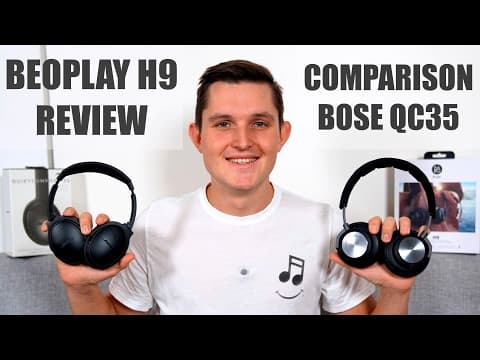
Best Bluetooth Wireless Headphones? B&O Beoplay H9 Review - In Comparison With Bose QuietComfort 35
Sander Saar reviews the B&O Beoplay H9 Bluetooth wireless headphones and compares them with the Bose QuietComfort 35 and Sony MDR-1000X. He begins by unboxing the Beoplay H9, showing the headphones, soft carrying pouch, 3.5mm audio cable, micro USB charging cable, and manual. He then examines the build quality and hardware, including the leather headband, lambskin ear cushions, earcup touch controls, replaceable battery, weight, and price, placing the headphones side by side with the Bose QuietComfort 35. The review covers Bluetooth 4.1 and 4.2 connectivity, multi-device support, and the iOS and Android companion apps for both models. Sander also evaluates sound quality, soundstage, and long-term wearing comfort, before comparing materials, sound profiles, connectivity issues, and active noise cancellation ear pressure across the Beoplay H9, Bose QuietComfort 35, and Sony MDR-1000X. He concludes that he will keep the Beoplay H9 as his universal headphones, while noting a preference for a lower price, multi-device Bluetooth, USB-C, and a hard case.
Watch on AgentTVAsk about this video
Chapter summaries
Hunt for the best Bluetooth headphones
Sander introduces his search for the ideal Bluetooth wireless headphones, listing several brands he has tried before settling on the B&O Beoplay H9 for review.
On screenSander sits on a grey couch against a plain white wall, wearing a white t-shirt with a black music-note graphic. Two white headphone boxes sit behind him, and brand logos and headphone graphics appear around him before a stylised blue-grey title card.
Unboxing the Beoplay H9
Sander unboxes the Beoplay H9, showing the packaging and revealing the headphones, soft carrying pouch, 3.5mm audio cable, micro USB charging cable, and manual.
On screenAn overhead shot on a grey fabric surface shows hands rotating the white Beoplay H9 box, sliding off the lid, and lifting out the black headphones, foam insert, soft pouch, and bundled cables.
Hardware, controls, and build quality
Sander examines the Beoplay H9's leather headband, lambskin ear cushions, touch controls, replaceable battery, weight, and price, comparing them directly with the Bose QuietComfort 35.
On screenClose-up overhead shots show hands flexing the Beoplay H9 headband, comparing it side by side with the matte black Bose headphone, demonstrating touch gestures on the metallic earcup, and removing the white battery, interspersed with Sander speaking on the couch.
Bluetooth connectivity and companion apps
Sander compares Bluetooth pairing, multi-device support, Bluetooth 4.1 versus 4.2 standards, and the iOS and Android companion apps for both the Beoplay H9 and Bose QuietComfort 35.
On screenSander speaks from the grey couch with Bluetooth 4.1 and 4.2 labels appearing in the upper corners, followed by two overlaid smartphone screens displaying the Bose and Beoplay app interfaces.
Sound quality and profile comparison
Sander shares his impressions of the Beoplay H9's bass, mid-range detail, high-volume comfort, and soundstage compared with the Bose QuietComfort 35.
On screenSander speaks on the grey couch, then appears in a split-screen view wearing black over-ear headphones and turning his head from side to side against a plain white wall.
Fit and long-term wearing comfort
Sander evaluates the long-term comfort of the Beoplay H9 and Bose QuietComfort 35, noting that adjusting the H9's headband tension prevents ear fatigue.
On screenSander speaks from the grey couch before a split-screen view shows him wearing the black over-ear headphones from the front and in profile.
Comparing Bose QC35 and Sony MDR-1000X
Sander compares the Beoplay H9 against the Bose QuietComfort 35 and Sony MDR-1000X, discussing materials, sound profiles, connectivity issues, and active noise cancellation ear pressure.
On screenSander sits centred on the grey couch against the white wall, gesturing with his hands while speaking to the camera, with the two headphone boxes visible behind him.
Final verdict on the Beoplay H9
Sander concludes that he will keep the Beoplay H9 as his universal headphones despite wishing for a lower price, multi-device Bluetooth, USB-C, and a hard case.
On screenSander speaks to the camera from the grey couch, gesturing and clasping his hands, before the video ends with a blue textured title card.
Transcript
Hi everybody, I'm Sander and I believe in technology. Ever since some of the first Bluetooth wireless headphones came out, I've been on a hunt to find the best ones. I've used more than 8 pairs from Beats, Bose, Bang& Olufsen, V-Moda, Sennheiser, Master& Dynamic, and Parrot. But for many reasons, I've never settled because they've not been perfect. Even in my current setup, I currently have the Audio-Technica M50s for editing, I have the Beoplay H6 2nd generation for home music listening, and the Bose QC35s when I'm traveling.
I think I found the one pair that are really like, for now anyway. Let's take a look at the Beoplay H9. I was a fan of Bang& Olufsen in the '90s when they, when I experienced some of the first TVs and home systems that came out. I never owned one, but when I got a chance to experience it, I was always positively surprised. I tried them early when they brought out their first wireless Bluetooth products, and I wasn't very impressed.
Actually, I was rather disappointed when I tried the Beoplay H7. But when Bang& Olufsen says they're in the business of goosebumps, they managed to deliver the 3rd time since 2016. I changed my Bose SoundLink Mini 2 to use the Beoplay A1 speaker system. I changed my Jaybird Freedom Xs to use now the Beoplay H5s, and now the H9. Let's take them out of the box, look at the build quality, connectivity, sound, some of the competitors, and the overall experience.
The Beoplay H9 come in a contemporary colorful box as opposed to the boring gray ones that all the other ones used to come in before, and it just screams quality all around it. While opening up, the first thing obviously we have the headphones here on the top, and when we take that off, you also have the carrying pouch in one of the boxes, which is just a soft case. Then you also have the cables, the 3.5mm headphone jack as well as the micro USB cable for charging the headphones, and also you have the manual in a third one.
First of all, let's take a look at the build quality. The Beoplay H9 definitely have a super premium feel to it. It has a cow leather headband which you can adjust the tension by loosening it or strengthening it. It has lambskin memory foam ear cushions which are super soft and super nice even over long periods of time. It also has a minimal clamping force which is a key thing when wearing for a long time because you can loosen it or strengthen it to your own needs.
It also has sliding ear pads instead of those resistant clicky ones which you have normally which make it very fluid to use, and they stay in place very well. None of that can be said to the QC35s. They're made at a really high standard, but they still leave a very plasticky feel, and they're not very durable over a long time. When looking at the controls, the Beoplay has the touch controls on your right earcup, which have had some controversial reviews, and I agree with them because on the first, the H8 and H7 headphones, they did not work very well.
But on this one, I've had no issues whatsoever. So there are several movements. You can rotate your finger to adjust the volume up and down. You can swipe on the right and to forward the song or backwards to go to the previous song. You can swipe down to turn off the active noise cancelling or swipe up to turn it on. You can also just tap on it to play and pause the music, and you can use the same to answer a call and also hold on the earphone itself to reject the call.
The only tactile button on Beoplay H9 is is the on and off switch and also turning it into a Bluetooth pairing mode or switching between different devices. The Bose QC35s, on the other hand, only house tactile buttons. First of all, the button to turn it on and go into a pairing mode, and then 3 buttons below where you can pause and play the music, turn the music up, turn the music down, and also use Siri or any other voice assistant, which is a big deal and big benefit of using Bose.
But you cannot turn the active noise cancelling on and off as you can with the Beoplay H9. Both headphones also have microphones for making calls, and they're really good, which I couldn't say of the previous versions of Bluetooth headphones that I've used. They also have microphones inside to adjust the active noise cancelling to the environment around you. Both of those also house 40mm drivers for the sound.
The differences come when you look at the weight the battery time, and the price for these headphones. Bose are definitely one of the lightest wireless over-ear headphones that I found at 234 grams, while the Beoplay are not the heaviest, they're still coming in at 295 grams. The Sony MDR-1000Xs, for example, are at 275 grams. The Bose and Sony equally allow you to play music for 20 hours using active noise cancelling, while Beoplay gives you 14 hours.
The benefit of Beoplay compared to the other ones is that you can replace the battery for a very low cost, so you can carry a couple with you and extend the battery life for a very long time. There's also a massive price difference. The Bose QC35s are at $349 and sometimes even on sale for lower, while the just-announced Beoplay H9s are $499. This is something to consider when you're looking at the pros and cons, whether you can actually justify that $150 difference.
Let's talk about connectivity. While it's very easy to go into the pairing mode on both of these headphones by sliding the power button and connect to all of your devices, be it your laptop, your computer, your phone, your tablet, your watch, whatever it might be, I've had no issues with either of these devices whatsoever, Bose still has a massive advantage because Bose can connect to multiple devices at the same time, meaning you can pause your music on your phone and play a video on your computer and and it will seamlessly go over from one device to another.
On the Beoplay H9, you would have to slide the Bluetooth button again to go and change the device to another one, be it from your phone to your computer. That's a hassle, but you'll get used to it, and I'm actually not switching that often anyway. On the other hand, while Bose QC35 support the Bluetooth 4.1 standards, the Beoplay H9 supports Bluetooth 4.2 standards. While there's no new sound profile introduced that will make a massive difference in the quality, The 4.2 has increased bandwidth that it can carry, so potentially higher bitrates for music as well, higher security standards, as well as ability to connect directly to the internet using the IPv6 protocol.
Both of these headphones also support connecting to your app on iOS and Android devices. In this app, you can update your headphone software, and by the way, the connectivity on the QC35s has got much better through the updates that I've got through the app. You can do the same using a Beoplay app, but I haven't got any updates as of today. You can also control the music playback within that app. In Bose app, you can also control the devices it's connected to because its ability to connect to multiple devices and change the name of the device.
In addition to that, in the Beoplay H9, you can also adjust the sound profile, which you can't do in QC35. So while you might be listening to podcasts that might have a much flatter profile while listening to rock music, have much more amplified bass and highs. You can't do that on QC35s. Talking about sound, the first thing you need to do is listen to them yourself because there's no other reviewer that can replicate your ears or tell you how they sound.
But I will still give you my opinion. Sound is the biggest difference for me and the reason I like the H9 so much. It is really deep and punchy in its bassline. It's got finer details in the mid-range that I couldn't say for the QC35s. It's got no roll-off for highs, so you don't get that tinging or ear-ringing sound when you're listening at really high volumes, and it's not fatiguing your ear. I couldn't say that to the QC35s because I rarely listened to them at loud volumes because it was really fatiguing.
The H9 also has a much more pronounced soundstage, so you feel as if you were in the room when the sound was recorded. And the sound gets even better when you wire it to a sound source, while the sound for QC35s is equally good when you connect it through a cable or listening wirelessly. But take my opinion on the sound with a pinch of salt, as every ear is different, people's preferences are different. The good thing with H9 is you can adjust the soundstage, so you can add more bass or take it off, add more highs, whatever your preferences is, which you can't do on the Bose QC35s.
Talking about the fit and comfort, Bose until now was the most comfortable headphone that I ever worn for a longer period of time. But also, after wearing the H9s over a longer period of time while traveling, at home, there's literally no difference. Once you adjust the headband to the strength and the clamping force that's comfortable for you, you can equally wear them for many, many hours in a row and not get that tension or a sweaty feeling in your ears.
Talking about the competition, I'm a big fan of Bose, but I was never impressed by the looks of their headphones and also their choice of really cheap materials while they're building them. At the relatively high price they're asking for their headphones. I also did not find the sound profile very pleasing, especially when listening at lower volumes. It's got very pronounced lows and highs, but not much happening, no much detail in the mid-range. And when you go at higher volume, I really get that ear-fatiguing, tingling sound from the highs when I'm listening to Bose.
The Sony MDR-1000Xs definitely sounded better, and in my mind were the best-sounding wireless headphones that I used since I used the Beoplay H9. But the Sonys for me had several connectivity issues with my laptop especially, which might be solved for now. But moreover, much bigger flaw for me for the QC35s and the MDR-1000Xs was the pressure that I was getting in my ears. I'm quite sensitive to ANC and I'm aware of that, so I haven't been really enjoying the QC35s as much in loud environments because it automatically adjusts the ANC level and there's no way to turn it off for a minute to let my ears relax and turn it back on.
While on the Beoplay H9, I've been quite comfortable with them, so they must be doing something different there. Or is it just the fit that makes it different? And I also have the ability to turn it off anytime that I don't want to have that feeling, but I get the pressure very little and very rarely. By the way, this is totally personal and very different. There are people who don't care about the ANC at all, they don't feel the pressure. There are people who are super sensitive. I count myself somewhere in the middle, probably more towards being sensitive.
And that's why I also wanted to bring out that I've had a different experience with H9 than any of the previous ANC headphones that I've used. So to conclude, I will keep my H9 headphones for now. I will sell my H6 headphones as well as the QC35s, as they will be merged into the one headphone that I can use universally for now. Yes, I also wish that they were $150 cheaper, that they also were able to connect to multiple Bluetooth devices at the same time, that they had USB-C connectivity, that they also included the hard carrying case as the Bose QC35s.
But there is no Swiss Army knife of everything. There is no one camera to suit everything. There is no one headphone to suit everybody. You always have to make compromises, either in sound, build quality, price, or otherwise. Thank you very much for watching this video. I hope you found it useful. Please let me know in the questionnaire here which ones are your favorite Bluetooth wireless headphones. If they're not listed here, please leave them in the comments below and let's have a conversation.
Please subscribe to my channel to see my future videos, and I hope to see you next time.