







Platform War - iOS vs Android - Apple vs Google - Comparison
By Sander SaarPublished Updated Length
Loading YouTube player.
Platform War - iOS vs Android - Apple vs Google - Comparison
Sander Saar compares the iOS and Android platforms from a seated, to-camera setup supported by overlaid charts, infographics, and product graphics. Drawing on his experience using devices from the original iPhone to the iPhone 6 and the Nexus One to the Nexus 5, he contrasts Apple's hardware-focused business model with Google's reliance on advertising and cloud services. He examines how iOS 8 and Android L have converged in features such as HealthKit and Google Fit, CarPlay and Google Auto, HomeKit and Nest, and 64-bit support, while weighing pros and cons including Android's update delays and fragmentation against Google's app ecosystem and iOS's lead in developer revenue. The comparison also covers hardware market share, build quality, and specifications across devices like the iPhone 5S, iPhone 6, Nexus 5, HTC One, LG G3, and Samsung Alpha, alongside Google's rapid innovation versus Apple's integrated hardware-and-software approach. Finally, he contrasts after-sales support experiences between a Galaxy S3 repair and an Apple Store replacement, notes his current preference for the iPhone 6 camera, and looks ahead to Samsung's Tizen OS, Microsoft's Windows Phone, and the Nexus 6.
Watch on AgentTVAsk about this video
Chapter summaries
Introduction and smartphone history
Sander introduces himself as both an Apple and Android fan, aiming to share an objective comparison of the two platforms. He recounts his personal history using Android devices from the Nexus One to the Nexus 5 and iPhones from the original model to the iPhone 6, noting that the best phone depends on individual values.
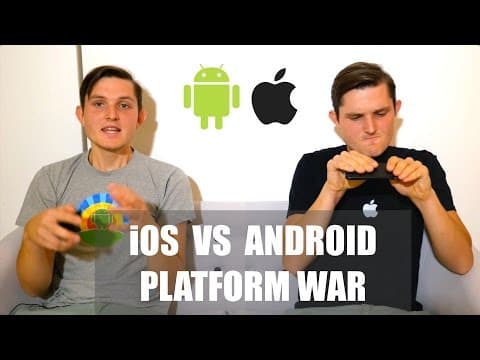
On screenA split-screen view shows a young man seated on a light grey, button-tufted couch against a plain white wall, appearing on the left in a grey Android-logo t-shirt and on the right in a black Apple-logo t-shirt, both holding black smartphones. After an animated title card reading ANDROID vs iOS PLATFORM WAR, he appears alone on the couch in a white MAKER t-shirt holding two black smartphones, with inset smartphone graphics appearing briefly on the screen.
Business model comparison
Sander contrasts the core business models of Apple and Google, explaining that Apple generates revenue by selling expensive hardware while Google makes money through advertising and media to drive device prices down and move users to the cloud.
On screenThe man in the white MAKER t-shirt sits on the light grey couch against a plain white wall, holding black smartphones and speaking to the camera. Two stacked area revenue charts for Google and Apple are overlaid in the lower left and right corners before fading out.
Software and operating system comparison
Sander notes that iOS and Android have become very similar, especially when comparing iOS to pure Android on Nexus devices rather than carrier-modified versions. He highlights how both platforms constantly match each other's features, such as HealthKit and Google Fit, CarPlay and Google Auto, HomeKit and Nest, and 64-bit support.
On screenIn a brightly lit indoor room against a plain white wall, a young man with short dark hair sits centered on a light grey fabric couch with multicoloured tufted buttons. He wears a white t-shirt with three dark vertical bars and the word MAKER, with a small black lavalier microphone clipped to his collar. Throughout the chapter, he holds a black smartphone in each hand and gestures with them while speaking to the camera. A picture-in-picture inset appears in the lower right corner showing two white HTC smartphones on a light wooden surface with illuminated home screens, app icons, clocks, and PHANDROID text before fading out. Later, large graphic panels appear on both sides of him showing smartphone lock screens, first with dark teal backgrounds, clocks, and notification lists, and then switching to a purple mountain landscape on the left and a blue starry-sky wallpaper on the right with clocks and unlock prompts. These are followed by vertical graphic panels flanking him with platform logos and names: on the left are panels for Google Fit with a multicoloured heart icon, androidauto, and a blue works with nest panel, while on the right are panels for HealthKit with a stacked heart icon, Apple CarPlay with a green icon, and HomeKit with an orange layered icon. The chapter ends with the graphics gone, returning to a wider view of the man seated on the couch holding the two black smartphones.
Operating system pros and cons
Sander discusses the challenges of Android's slow update cycle caused by manufacturers, chipmakers, and carriers, contrasting it with Nexus and iOS updates. He also notes how Google's software ecosystem, including Gmail, Drive, Calendar, and YouTube, dominates his daily life, while iOS still leads in developer revenue and avoids Android's screen-size and OS-version fragmentation.
On screenThe man speaks from the light grey couch while various graphics appear, including a full-screen device update table, a scrolling dark grey infographic detailing the anatomy of an Android OS update, a green Android robot next to a Samsung phone, Google service icons, a Canalys download revenue pie chart, and a collage of phone brand logos alongside OS version pie charts.
Hardware and devices comparison
Sander compares the hardware market, noting that while Android holds around 60% of the market share, Apple's iPhone 5S and iPhone 6 dominate premium sales. He explains that specs alone do not guarantee quality, citing the 8-megapixel Sony sensor in both the iPhone and Nexus 5, and praises Apple's build quality alongside improving high-end Android phones like the HTC One, LG G3, and Samsung Alpha.
On screenThe man sits on the light grey couch holding a black smartphone in each hand and gesturing while speaking to the camera. Partway through, graphics of a black LG phone on the left and a black HTC phone on the right appear beside him.
Software and hardware integration
Sander explains that Google innovates rapidly to attract users, whereas Apple often waits to deliver a complete hardware-and-software solution, as seen with the iPod and iPad. He illustrates this with big-screen phones, noting that early large Android phones simply zoomed in on apps, while Apple waited for developers to optimize for larger displays.
On screenThe man sits on the light grey couch holding two black smartphones and speaking. Inset images of early portable music players, an iPod, a bulky grey tablet, and a slim black tablet appear, followed by graphic smartphones flanking him that display social media app layouts.
After-sales support
Sander highlights the importance of after-sales support, contrasting his week-and-a-half wait for a Galaxy S3 repair with getting an immediate iPhone replacement at an Apple Store for a camera issue. He points out that Apple's control over both hardware and software prevents the blame game common among Android manufacturers and carriers.
On screenThe man sits on the light grey couch against the plain white wall, wearing his white MAKER t-shirt and holding two black smartphones while speaking and gesturing to the camera, with no overlaid graphics.
Future outlook and conclusion
Sander advises viewers to choose a phone based on their own priorities, software, hardware, support, and developer community, noting that he currently prefers the iPhone 6 for its camera. He looks ahead to Samsung's Tizen OS, Microsoft's Windows Phone after acquiring Nokia, and upcoming devices like the Nexus 6, before signing off and directing viewers to his recent videos.
On screenThe man speaks from the light grey couch holding two black smartphones, with brief lower-right graphics showing a Tizen television, a Samsung smartphone, and a smartwatch. The video concludes with an animated title card and a black end screen featuring three video thumbnails on the left and a red Subscribe button with social media icons on the right.
Transcript
Hi, I'm an Apple fan, Sander. Hi, and I'm an Android fan, Sander, as well. With regards to, with regards to lots of conversations happening around iPhones with iPhone 6 launch and iOS versus Android, I just wanted to share some of my thoughts and hopefully in an objective manner. So we want to look at hardware, then also software side, how the service side looks like, and both from developer and also consumer perspective, and also see what the future will hold for both of them.
I've been an Android user from the very first day when Nexus One came out and been using Galaxy S2, S3, S4, and also Nexus 5 now. With regards to iPhone, I've also been using it since the very first iPhone and now up to iPhone 6, every, every model in the way. And I'm really excited about that. I And I do that for 2 reasons. First of all, I'm just really excited about the development and the fight between those 2 platforms, but I'm also really keen to find the best phone for myself, which is always going to be a balance and comparison of values and features.
There is no best phone in the world. What is best depends on the values you have and also who's measuring it. So if it's you or someone else, it could be something totally different. So I'm going to be as objective as possible or share some ideas with you that I consider or think about when I look at those 2 very competitive platforms. One who's making money by making hardware and making it really expensive, and the other one who's making money via advertising or media, who's trying to drive the device prices really down and take everything up to the cloud and make money there.
So first, when you look at the operating system, they're so similar, especially after Android 4.4 to, they're both great phones to use out of the box. With regards to Android, I think there's one thing I need to clarify. Android devices could mean anything. For me, when I talk about Android now, they mean clean, pure Android OS from a Nexus phone. So if you think about an HTC phone, it could have an operator version, so it could be someone like AT&T version or O2 version, whoever you're using.
When you're, it could have a second version which is Google Play Edition, which is probably as close as it gets to the Nexus phone or the purest Android. And then also they have developer editions, which are all 3 completely different Androids. But here I'm talking about the purest Android on Nexus devices. Those 2 operating systems have always been in a fight, and they've become so similar after probably Android 4.2. So if Apple now introduced Apple HealthKit, Google has Google Fit.
If Apple introduced iOS CarPlay, Android introduced Google Auto. If iOS introduced Health, HomeKit, then Android introduced Nest Developer Kit. So as you can see, they're always fighting between each other, and that's what's driving the ecosystem. iOS 7 was 64-bit first. Now Android L also supports 64-bit. The biggest challenge here is, as you can see, it's an update race, is that most of the Android devices are not kept up to date.
For example, when I was using Galaxy S2, I had to wait nearly a year, actually even more than a year, because my Android version was like 3 major updates behind, which is the biggest limitation because I could know all of those features are available but not for me. HTC has published a great graph to show why is that. So first of all, when an Android version is released, it goes through the manufacturer, and the manufacturer will send it through to the chipmaker.
The chip manufacturer will then look whether it's possible to integrate with the new Android OS, and then will make a decision whether to build the drivers for it or not. Once the drivers are built, then for example HTC will start building their version of the new Android operating system. Once that is built, they will also start building a layer for the operator, mobile operator, and then any additional apps that need to be updated.
So it's a fairly long cycle, and most of the time they just can't make it happen before the new model already comes out, and it's a year-long wait since their last version. That's not the case with Nexus 5 or any Nexus phone because Google is doing their best to keep it updated all the time. Compared to iPhone, for example, iOS 8 is even available for iPhone 4S, which is 3 years old or 4 version generations old phone now.
But you can still run the latest. The slow cycle for Android is generally for a few different reasons. First of all, you got a phone which has a blank Android. Let's call that this Nexus phone. Generally then, the manufacturer will add in their own software. So in this case, let's say it's a Samsung, and Samsung add their S Pen or S Health applications on it. Then they go to an operator. An operator, let's say it's O2. O2 wants to add their own entertainment apps on top.
And then when it gets to the consumer, consumer will install their apps. So you'll have this thick of apps on the phone or just additional software that is not needed and was not meant to be there when Android was founded before it was even sold to Google. So it's really important to understand that Android in its purest is great operating system. Android with the full stack, I'm not a big fan of. At the same time, when I talk about software, pretty much Google has taken over my life, to be honest.
So all my emails are in Gmail, my work email is in Gmail, and I'm using Google Drive for hosting my files, I'm using Google Calendar, I'm using Google Photos, I'm using YouTube for my entertainment. So pretty much all of my life is in the hands of Google. So from software perspective, they've done a great job getting people on their platform. Both the platforms also have great app stores available. I think generally equal amount of apps, and most of them are covered on both platforms.
The only difference here is that most of the apps come out on iOS platform first and then on Android. The pure reason here is that though Android is dominating the market of its devices, the revenues that developers get are still 60 or 70% coming from an iOS device, and that's a very simple reason why they always do iOS devices first. Another reason which leads more into devices, and I'm talking also from developers' perspective, is that Android is such a fragmented marketplace.
It's not just the versions, software operating versions that are out there, but also the screen sizes. For example, Samsung itself has 27 different screen sizes being sold at the moment, while iPhone has 6 in its lifetime. So that's again a massive differentiator and makes life so much easier for developers. Talking about devices, Android has the biggest market share. Nearly 60% or 58% of the market belongs to Android and around 40% to iPhone.
When talking about devices, iPhone 5S was since last month still the number one top-selling smartphone in the world, even after one year after its launch. As compared to, for example, Galaxy S4, which, which sold 10 million units in 30 days, iPhone 6 sold 10 million units in 3 days. So on the premium market, there's no doubt that Apple in the hardware space has got its lion's share.
Hardware doesn't make all the difference. You can have the highest specs, but it's not going to deliver value if it's not well integrated with the software. A great example of that is that both of the Nexus 5 as well as the iPhone had an 8-megapixel Sony image sensor inside. One of them delivers amazing image quality, the other one is just so poor that in most of the daily scenarios I would still need to use my pocket camera. Obviously the difference in focus shows also in device build quality.
Apple is just in its own league with a glass and metal back. At the same time, most of the higher-end models such as HTC One, the LG G3, and the Samsung Alpha phones are just getting better and better, and they're so close now that it looks and feels even exactly the same. But it's just the difference is how well the software and hardware come together. So the ideology of the ecosystem is just very different, how they're making money, and that's what also derives the difference in, in how, how we're using those devices.
While Google is always innovating, bringing new features to the market, and trying to be first to grab as many people to their platform as possible, as they're making money that way, then Apple is probably never first. For example, iPod, there were loads of music players that even looked similar before that, but the biggest issue of music distribution wasn't solved. They didn't come up with a solution before that. For example, another one is an iPad. Microsoft had a try in 1991, then 2000s, didn't work out.
Apple came with a full solution, how software and hardware work together, And then it was picked up by developers and now it's a big success. So while Android is all about software, you're also going to have those great specs in those phones. But specs doesn't make the phone, but how the software and hardware work together, that's what makes the phone different. So looking at how hardware and software should work together, I think the best example is when the big screen started appearing for Android phones because there was very limited support from developers.
So most of my applications that I just had on smaller screens were just zoomed in on the bigger screen. So why would I carry on with the bigger screen just to see the same thing larger? I think that was again another example to show why Apple wasn't the first in the market. They just waited for developers also to come on board, understand how they can use the larger real estate that users will have in the palm of their hands, and also to leverage and take full use of that.
Another interesting thing that a lot of people don't think about when they buy a phone is the support or after-sales side. So when Apple has its shops all around the country, then most of the Android manufacturers and Google themselves don't have those shops around the country, though Samsung is now building their network. A good example of that is when I had issues with my Galaxy S3 phone when it didn't want to start anymore and I had to take it back to the store.
Then I went there, they took it to their expertise, it took them a week and a half to come back to me, so I was just without my smartphone. Another example in contrary, when I went to Apple Store and I had issues with my camera, so it always had those dots in the camera when I was taking photos, I just took 2 sample images and then I was given a new phone straight out of the box without any questions asked. That's what makes a difference for me as well when I think about buying a phone.
There is no way to play the blame game when you are responsible for the hardware and software yourself. While on Nexus devices the blame game is easy to come because the software is not good enough, or it's not integrated with the hardware manufacturer, or it's due to your cell operator in your country. So what the future holds like, so don't just listen to the guys who say, hey, you must be Apple fanboy or just dumb user when you're buying an iPhone.
No. Or you might be against iPhones just to show your rebellion to buy an Android phone. I think you need to think about it from your perspective. What is important for you? And what you care about or need to use every day. And those things to consider are: is the software, is the hardware, is the support, and is the developer community around it? None of these phones are perfect. Apple has its major downsides as well as Android has its major downsides.
For me, iPhone 6 is the best phone to use just because I care so much about the camera. Though I use most of Google apps on iPhone and they work just great because Google is a software company, it's developing those apps to iPhones as well. And software company as they are, they're trying to lock manufacturers more and more in. For example, they just made more restrictions for Samsung or other manufacturers to include all Google apps on their home screen when they're launching their new phones. While Samsung has now paired up with Intel to actually start building their own operating system, Tizen, which will launch in smartphones in Russia at the end of this year, and they've already brought it to their Galaxy Gear watches.
So there's lots of change coming up there. Windows Phone is also really interesting now after Nokia's acquisition, how the Microsoft phones will look like. Like, maybe they will be the next phones that we're going to use. So I'm really keen always to follow that fight. Today I think iPhone 6 is the best phone I can use. Maybe when Nexus 6 comes out, I think that that might be the best one. The next one might be Lumia or even an update to an iPhone or a new Android phone.
We don't know. So let's keep our eyes on, always think about what's important to you, what's valuable to you, what do you use, and then compare that to how much you have to pay for it. And then make up your mind, because there's no right answer, there's no wrong answer, there's only answer that's best for you. And by the way, this is just my perspective. Someone else's perspective might be completely different, so keep that in mind as well. Thank you for watching and see you next time.
Thanks very much for watching. If you enjoyed the video, please give your thumbs up just below the video.
On the left-hand side, you will also find some of my recent videos about drones, about Google Glass, and about 3D printing. And on the right-hand side, you can keep yourself updated by subscribing on YouTube, liking on Facebook, following me on Twitter or Instagram.