











Completely Unfair Camera Battle - iPhone 6 vs Sony RX100 III vs Sony A7S - Which One To Buy?
By Sander SaarPublished Updated Length
Loading YouTube player.
Completely Unfair Camera Battle - iPhone 6 vs Sony RX100 III vs Sony A7S - Which One To Buy?
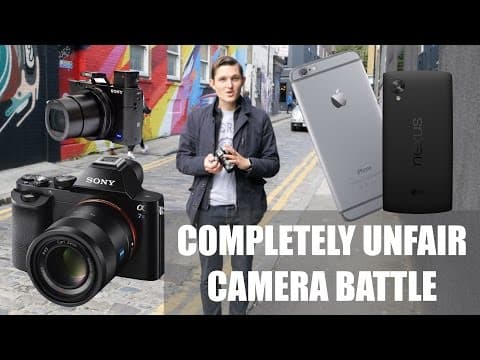
Sander Saar compares the iPhone 6, Nexus 5, Sony RX100 III, and Sony A7S in a street-testing camera comparison shot in London. He introduces the specifications of each device, including the Sony A7S full-frame mirrorless camera, the Sony RX100 III compact camera with a 1-inch sensor and Zeiss lens, and the smartphones, and explains how sensor size, glass, and software processing affect image quality. Using side-by-side photographs and video clips captured around street art on Brick Lane, outdoor markets, indoor spaces, and the River Thames at night, he evaluates field of view, detail and sharpness, autofocus speed, video stabilization, slow-motion recording including the iPhone 6's 240 frames per second mode, depth of field and bokeh, dynamic range, image processing, and low-light noise performance at high ISO settings. In his conclusions, he reviews the strengths of each camera type, describing the Sony RX100 III as a pocketable travel camera, the Sony A7S as a full-frame option with 4K video output and low-light performance, and high-end smartphones as all-rounders for most situations. He finishes by stating his personal decision to sell the Sony RX100 III and keep the iPhone 6 for everyday use and the Sony A7S for demanding situations.
Watch on AgentTVAsk about this video
Chapter summaries
Introduction
Sander introduces himself and the camera comparison between mirrorless, pocket, and smartphone cameras.
On screenA man wearing a dark jacket over a light grey t-shirt and dark jeans stands in the middle of a cobblestone street in daylight. He holds a small black smartphone in one hand and a black camera in the other, gesturing as he speaks toward the camera. The street features yellow double lines, a building covered in a colourful red, yellow, blue, pink, and teal mural on the left, a dark grey building on the right, and pedestrians and trees in the background. The video then cuts to full-screen animated title cards on a textured blue-grey background with red, black, and yellow bars displaying white text that reads "BROUGHT TO YOU BY SANDER SAAR".
Sony A7S
Sander outlines the key specifications of the Sony A7S, including its full-frame sensor, ISO range, video capabilities, and lenses.
On screenA man in a dark grey jacket, light grey graphic t-shirt, and dark jeans stands on a sunny cobblestone street lined with buildings covered in bright red, yellow, blue, pink, and teal murals, holding a black Sony a 7S mirrorless camera and gesturing while speaking as pedestrians walk by and a silver taxi drives past in the background. Close-up shots over a grey weathered wooden surface show two hands holding and rotating the black Sony camera to display its large lens, side profile, top dials, buttons, hot shoe, and rear screen showing a live view of the wood and camera settings indicators. In another close-up, the hands twist and detach the lens, holding it beside the exposed camera mount. Back on the cobblestone street, the man points at the Sony camera while speaking, and later holds and turns a much smaller black compact camera in his hands, with a camera in a pouch at his side.
Sony RX100 III
Sander presents the Sony RX100 III, highlighting its 1-inch sensor, Zeiss lens, video codecs, ND filters, and built-in viewfinder.
On screenClose-up shots in daylight show hands holding and rotating a matte black Sony RX100 III compact camera over a weathered wooden surface. The rear screen displays a live camera view with settings overlays, and the hands turn the camera to show its top mode dial, controls, and extended cylindrical Zeiss Vario-Sonnar T* lens. The scene cuts to a man in a dark grey jacket over a light graphic t-shirt and jeans standing on a sunlit cobbled street in front of a brightly painted red, yellow, pink, and blue geometric brick wall, with buildings, a parked car, and pedestrians in the background. He holds the small black camera, speaking, gesturing, and looking down at it as the view shifts from a wider street shot to a tighter waist-up angle. Returning to close-ups over the wooden surface, hands raise the camera's pop-up viewfinder and press the control wheel to navigate a settings menu on the rear screen. Back on the sunlit cobblestone street in front of the colourful geometric mural, the man holds a black smartphone while speaking, followed by an extreme close-up of a hand tilting the back of a silver smartphone to show its raised rear camera lens, flash, dark fruit-shaped logo, and side buttons against a blurred street background.
Smartphones
Sander introduces the smartphones in the test, focusing on the iPhone 6 camera specs and mentioning the Nexus 5.
On screenA man in a dark jacket, light graphic t-shirt, and jeans stands on a sunlit cobblestone street speaking to the camera while holding a smartphone and gesturing. Behind him is a building with a large colourful geometric mural in red, yellow, blue, and teal, along with other buildings and distant pedestrians in daylight. A small on-screen caption in the lower left corner reads "*Phase-detection Autofocus", and the text "TOWER CARS" also appears on screen. The view widens to show more of the street, the mural on the left, buildings on the right, and the man's shadow on the pavement as he holds the smartphone in both hands.
What makes a good image
Sander explains the three main factors behind a great image: sensor size, glass, and software processing.
On screenA man in a dark jacket over a light graphic t-shirt and dark jeans stands on a sunlit cobblestone street in front of a wall covered in large red, yellow, blue, pink, and teal murals, speaking and gesturing to the camera. At the start, he holds a smartphone while a picture-in-picture graphic in the lower left compares relative sensor sizes using overlapping large pink, medium blue, and small green rectangles labeled Sony Alpha NEX-7, Sony Cyber-shot DSC-RX100, and Apple iPhone 6 (rear). The video cuts indoors to three devices slowly rotating on a light beige fabric sofa under artificial light: a large black Sony camera on the left, a silver smartphone with an Apple logo on its back in the middle, and a smaller black Sony camera on the right, showing their lenses, dials, backs, and rear screens displaying camera settings and a live view, with markings including SONY ZEISS FE 1.8/55 and Carl Zeiss Vario-Sonnar 1,8/2,8-3,3/8,8-25,7. The scene returns to the man standing in the middle of the cobbled street speaking and gesturing, occasionally holding a small dark object, while pedestrians walk past buildings and trees in the background.
Test setup
Sander explains the unscientific, everyday street-testing approach used to compare the cameras.
On screenOutdoors in bright daylight, a young man in a dark navy jacket, a grey graphic t-shirt with a purple circular emblem, and jeans presents to the camera. He appears first on a cobbled street with colourful murals and then on a busy paved sidewalk next to a brick wall covered in purple and black graffiti. He speaks and gestures with both hands while holding a small dark object in one hand. In the background are parked bicycles locked to a metal railing, passing cars, pedestrians, modern buildings, a distant arched structure, and a large building with stairs and a BOXPARK sign.
Field of view comparison
The presenter compares the field of view and focal length equivalents of the Nexus 5, iPhone 6, Sony RX100 III, and Sony A7S.
On screenAfter a brief shot of a cobblestone street, static still photographs of a brick wall covered in a vibrant geometric mural with white-framed windows are shown with camera and focal length labels, ending in a four-panel split screen comparing all four cameras side by side.
Details and sharpness
Sander compares image detail, sharpness, and shadow recovery across the iPhone 6, Sony RX100 III, and Sony A7S using street art on Brick Lane.
On screenAn outdoor street scene pans past brick buildings covered in murals, followed by still comparison photos of a large black-and-white hedgehog mural on a brick wall. The sequence alternates between wide views and cropped close-ups of the mural's head and ear, ending in a three-panel side-by-side comparison.
Focusing speed
The presenter tests autofocus speed and accuracy in a busy street market, noting that the iPhone 6 and Sony RX100 III focus faster than the Sony A7S.
On screenA man in a dark jacket walks through a busy outdoor street market on a cobbled street between brick buildings, holding a camera in his right hand as shoppers pass stalls with hanging clothes, a red and white striped tent, and a colourful graffiti mural. He crouches on the cobblestones to photograph three children holding white T-shirts in front of a green door and a bicycle while pedestrians and a stroller pass by. A sequence of labelled still photographs of outdoor market scenes follows. Photos labelled Sony A7S show a blurred shot and a sharp shot of the three children holding white T-shirts, followed by a street scene with a black motorcycle trike, a white van, a Controlled Zone sign, and several men in front of a red-brick building. Photos labelled iPhone 6 show the three children on the cobbled street with pedestrians in the foreground, a market stall with rows of red, green, blue, and yellow plastic bins, and a black London taxi converted into a coffee stand with a roof canopy. Photos labelled Sony RX100 III show a closer view of the black taxi coffee stand with a man behind it, the market stall with colourful plastic bins and a man in a white T-shirt leaning over the goods, and a group of men standing at a stall with hanging bags, clothes, signs, and a blue graffiti mural.
Video and image stabilization
Sander compares video quality and stabilization while filming a busking band, contrasting the Sony A7S's filmic look with the iPhone 6's built-in stabilization.
On screenDaylight street footage shows a three-piece busking band, a bassist in a plaid shirt and cowboy hat, a guitarist in a plaid kilt, and a seated drummer, performing on a pavement in front of shopfronts and market crowds, with on-screen labels switching between Sony A7S and iPhone 6.
Slow motion
The presenter compares slow-motion video capabilities across the Sony RX100 III, Sony A7S, and iPhone 6, highlighting the iPhone's 240 frames per second mode.
On screenAt an outdoor market food stall in daylight, a vendor in a white t-shirt, striped apron, and clear gloves cuts and trims a large green coconut with a knife over cardboard boxes, before cutting to a crowded market juice stall under white canopies.
Depth of field and bokeh
Sander demonstrates how sensor size and aperture affect shallow depth of field and background blur using outdoor market and indoor portrait shots.
On screenStill comparison photographs and three-panel split screens show hanging artificial fruit at an outdoor market stall with shoppers blurred behind it, followed by indoor portraits of a blonde woman in a tie-dye sweater standing between two illuminated crumpled-paper sculptures.
Dynamic range
The presenter tests dynamic range in high-contrast scenes, comparing how the Nexus 5, iPhone 6, Sony RX100 III, and Sony A7S handle bright lights and dark shadows.
On screenStill photographs and four-way split screens show a circular illuminated carousel installation with black horse silhouettes in a dark indoor space, followed by vertical still photos and a three-way split screen of a tall brick chimney against a bright blue sky.
Image processing and details
Sander shows how in-camera image processing affects fine text and object details in well-lit conditions across all four devices.
On screenSuccessive static indoor shots under artificial light show a white wall covered with light wooden framed display boards holding neatly arranged disassembled objects in black, silver, gold, blue, and red, including phones, pens, tools, circuit boards, a black flashlight, rings, and hair clippers. A white poster with a QR code and dark printed text reading 'The Narrative' and 'THE POLOBAR CAFE HAS BEEN DESIGNED AND INSTALLED BY THE NARRATIVE' is at the lower left. Full-frame comparison images of the wall appear one after another with white camera labels at the bottom centre for the Nexus 5, iPhone 6, Sony RX100 III, and Sony A7S, varying in brightness. The chapter then shows a four-way split-screen comparison of a cropped section of the wall, featuring the display boards of pens and disassembled black phones above the white poster, with the Nexus 5, iPhone 6, Sony RX100 III, and Sony A7S panels labelled side by side at the bottom.
Low light and noise
The presenter compares low-light photo and video performance at high ISO settings, demonstrating the Sony A7S's superior noise handling over the other cameras.
On screenThe chapter begins with a series of still nighttime photographs of a riverfront city skyline framed with black side bars, showing dark water reflecting blue and white lights from a tall Ferris wheel, illuminated bridges, lit buildings, and a pier structure in the lower right. White text at the bottom left labels the camera and exposure settings as the images progress from a dark, grainy shot from the Nexus 5 to brighter photographs from the iPhone 6, Sony RX100 III, and Sony A7S. Next, a static four-panel split screen compares a night river scene featuring dark reflective water, an illuminated bridge, and warm yellow-lit historic buildings with a clock tower, with the two left panels much darker than the two right panels and white labels at the bottom reading Nexus 5, iPhone 6, Sony RX100 III, and Sony A7S. The view then shifts to static nighttime wide shots of the River Thames in London showing the blue-lit London Eye, an illuminated bridge, lit buildings, moored boats, and reflections on the dark water, with white text at the bottom left identifying settings for the Sony RX100 III, the Sony A7S, and a very dark image from the iPhone 6. The same wide night river view continues as the on-screen text steps through increasingly high ISO settings for the Sony RX100 III and the Sony A7S, with a lit boat moving across the water and the scene becoming progressively brighter. Finally, a static three-panel split screen compares the night river scene across the iPhone 6, Sony RX100 III, and Sony A7S, with the left panel darkest, the right panels brighter, and white camera labels along the bottom.
Conclusions on each camera
Sander introduces his final thoughts by noting that cameras are tools and the right choice depends on your needs, skills, and budget.
On screenA man with short brown hair sits centred on a light grey tufted couch with small coloured buttons against a plain off-white wall under indoor artificial light. He wears a grey sweatshirt with purple INTERNET lettering and an emblem over a white undershirt, along with dark jeans. A large black Sony camera rests on the couch to his right, and a small black compact camera rests to his left. He speaks to the camera while gesturing with both hands as the framing shifts between a medium shot and a tighter medium close-up of his upper body and face. Later, he turns to his left and picks up the small black compact camera with his left hand while continuing to gesture with his right.
Sony RX100 III
Sander summarizes the Sony RX100 III as a rugged, feature-packed pocket camera with a viewfinder, flash, zoom lens, and flip-out screen ideal for travelers.
On screenIndoors against a plain off-white wall, a man sits on a light grey tufted sofa with coloured buttons, wearing dark jeans and a grey sweatshirt with purple INTERNET lettering and a purple circular emblem over a white undershirt. He holds a small black Sony compact camera, turning it in his hands, pointing to its extended lens, raising it to his eye to demonstrate the viewfinder, and flipping its screen up and around while speaking and gesturing. A second, larger black Sony camera rests on the sofa beside him. The framing shifts between medium close-ups and wider medium shots, and toward the end he picks up the larger black Sony camera and holds it up with its lens facing the viewer.
Sony A7S
Sander highlights the Sony A7S's full-frame sensor, interchangeable lenses, 4K video output, and exceptional low-light performance for serious photographers.
On screenIndoors against a plain off-white wall, a man wearing dark jeans and a grey sweatshirt with purple INTERNET lettering and an emblem over a white undershirt sits on a light grey sofa with multicolored buttons. He holds a large black Sony camera with a prominent lens, turning it in his hands, pointing to the lens, and gesturing while speaking, while a smaller black compact camera rests on the sofa beside him. He picks up the smaller black compact camera to hold both cameras side by side, and later sets the camera aside to hold and turn a black smartphone in his hands while continuing to speak and gesture.
Smartphones
Sander compares smartphones like the Nexus and iPhone 6, noting that while they lack a full flash and viewfinder, a high-end smartphone is a great all-rounder for 80% of situations.
On screenIndoors, a man in a grey sweatshirt with purple lettering and dark jeans sits on a light grey tufted sofa with small multicoloured dots in front of a plain off-white wall. He speaks to the camera while holding a black smartphone and gesturing with his hands, then sets the phone down out of view. He later picks up a silver smartphone, turning it to show its back with a black logo, and subsequently holds and turns a dark grey smartphone while gesturing. A comparison graphic appears on the right side of the frame showing nested pink, blue, and small green rectangles to compare relative sensor sizes, with the labels Sony Alpha NEX-7, Sony Cyber-shot DSC-RX100, and Apple iPhone 6 (rear). After the graphic fades away, the man continues sitting on the sofa, holding the dark grey smartphone and gesturing while speaking to the camera.
Which camera I'm keeping
Sander shares his personal decision to sell the Sony RX100 III and stick with the iPhone 6 for everyday use and the Sony A7S for demanding situations.
On screenSeated on the light grey couch, the presenter holds up the compact Sony camera and then the larger Sony A7S while speaking, before waving goodbye. The video ends with animated title cards and a black end screen featuring four preview video windows, a Subscribe button, and social media icons.
Transcript
Hi, I'm Sander. Cameras have become such an important part of our lives. As consumers, there's a lot to offer in the market. There's fierce competition between those higher-end mirrorless cameras or DSLR cameras or phone cameras and pocket cameras. We want to know, and let's test out, how a higher-end mirrorless camera compares to a phone camera or pocket camera. Let's have a look. The first one we're looking at is Sony's mirrorless camera that was launched this year, A7S.
It incorporates a full-frame 35mm sensor and 12 megapixels on that sensor. It has a crazy ISO from 50 to 409,600. You can record images as well as RAW images, video, XAVC-S video, which is, and also with great cinematic picture profiles. So that's a great all-around camera and true professional beast. And with A7S, we're going to use Sony's own 55mm f/1.8 lens, but also their 24-70mm f/4 lens.
Which obviously are a big differentiator from other cameras we have in test. The Sony A7S has also built-in viewfinder, electronic viewfinder, nice big screen, and also full metal body with this, coupled with the Zeiss metal lens, it gives a really nice and rugged feel. So the second camera in the test is going to be the Sony RX100 III in the series. It incorporates 1-inch sensor. To put it in perspective, it's a third of the size of the A7S full-frame sensor.
It's still large for the body size. It also has a built-in Zeiss lens which is from 24 to 70mm field of view and f/1.8 to f/2.8 aperture, which is great. There's a ton of things packed in this body. Similar to the A7S, you can use the XAVC-S codec for video and also record in 720p 120 frames per second or Full HD 60 frames per second.
Again, very similar to the A7S camera. For the lens, it also has built-in ND filters and incorporates 20 megapixels on the sensor. Similar to A7S, the RX100 also has got a built-in electronic viewfinder and also a built-in flash, so it incorporates lots of things that you can't see in the first place on the camera but which make it a lot more useful. The RX100 also has a full metal body that leaves you this very nice solid feel and you never worry about your camera.
For the smartphone, we've selected the latest and, to my belief, also the best camera in a smartphone from iPhone 6. It has the same 8-megapixel sensor that you had in iPhone 5S, but they just changed the sensor pixels themselves to now be focus-detecting pixels. It has the same f/2.2 aperture lens, and the size of the sensor is roughly a third of the RX100.
For the smartphone, we've also incorporated in some of the clips the Nexus 5, just to show you the difference of the higher-end and the lower-end smartphones. To my mind, there are 3 things that make a great image. First of all, there's sensor, and for that we have the A7S with full-frame sensor, a third of that size RX100, and a third of that size, the iPhone 6 sensor. The second thing is obviously glass. Glass is super important. For A7S, we can use interchangeable lenses.
For RX100, we have fixed lens, but we have a really nice Zeiss lens in front of it. And for iPhone 6, we have a fixed built-in lens, and we see how those perform. The third most important part is obviously software. Because what happens after digital images are taken is the processing part, which sometimes ruins everything you have. But we'll see again, compare how they perform. This test is completely unscientific and completely unfair against all the cameras that are in the test.
But that's the goal with this test, is test when you would buy the camera, what kind of results you would get out of it as just a normal consumer from the street. For taking great images and videos, everything doesn't depend on the camera, it depends on the person behind it. For these test purposes, we're going to assume that I'm like going to be like everyday user taking videos and photos in the streets, of people in the nighttime, indoors, outdoors, and see how they all compare for the image quality, for the focusing, for the noise, and for the sharpness.
So the first thing I want to show you is the different field of view for the different cameras. On iPhone 6 and Nexus 5, we have a fixed lens which is roughly 3.8mm in focal length, which at a full-frame level would be 30mm field of view. The RX100 has a zoom lens, and at its widest it's 24mm equivalent on full frame, as the lens is roughly 8.8mm.
And then the full-frame Sony A7S with 24mm at its widest at the moment. And here you also have them all together. One thing to keep in mind is that you can still use the zoom on the iPhone and the Nexus 5, but you'll be losing in the resolution and image quality as you would just be cropping into the existing image. Rather than optically zooming in.
So that's something to keep in mind as you just have to walk more to frame your shots versus having this versatility of the RX100 and full-frame or any other interchangeable lens cameras where you can choose the focal length based on the lens you have in front of it. So next up, walking around Brick Lane, there are so many great drawings on different buildings. In this case, I'm comparing the details and dynamic range for iPhone 6 in the first place.
Looks great on the outside. As soon as we crop in, you can see we're losing the detail and the sharpness. And then next up, Sony RX100. It's much better in terms of sharpness, bringing out the details, and also showing you the details in the shadow area because of the dynamic range. And then the superior Sony A7S. Even when cropped in, you can still see the details in the shadow areas. And now all of them 3 compared side by side.
As you can see, especially in the right-hand side corner area, iPhone really loses and there's no detail really in drawing the lines between the bricks and also some artifacts in the hair because of the image processing. Sony RX100 much, much sharper because of probably the lens and also a lot more detail in the shadows because of the dynamic range. And then Sony A7S completely exceeding both of them in terms of detail, sharpness, and also the shadows or the details in the shadow areas because of the superior dynamic range.
In addition to the image quality One thing that is very important for a kind of all-around walking camera is focusing and the speed of focusing. With A7S trying to take pictures of different things on the street, for example, in this case I missed focus several times because either it was too slow or it just took pictures before actually nailing the focus. While I rarely ran into that issue with the iPhone 6, which was super fast with its new phase-detecting pixels, or even for that matter the RX100, which was really, really good in focusing.
That's something to keep in mind when working with mirrorless cameras. Another very important feature for a walk-around camera is obviously video, because it's so easy now to record video and to share video because of the bandwidth and also the great cameras we have in our hand. In this case, I'm filming the amazing rock pan at Brick Lane, and first up is the A7S where you can see this filmic or close-to-film look, this full-frame look with a shallower depth of field than other cameras.
Which I really, really enjoy. But also another great feature on the other hand is the iPhone 6 with its image stabilization built in, which also gives this very filmic movement to the images that you're taking. And it's still good enough to share on your social media or watch on the web.
It's probably not good enough to actually share On a big screen, or even if you want to watch that on your TV, it does not look as good as the full frame, but it's still definitely good enough for your everyday use. And when talking about video, also slow motion is one of the most talked about features for smartphones these days, and it's sometimes even overly used.
In this case, we are comparing the Sony RX100 60 frames per second slow motion slow motion. As you can see, it's very, very detailed. I really like that image quality. Then also A7S, which was missing focus for a little bit but then came back, and it's a great, great, colors remained and the details remained even in slow motion. So it looks absolutely fantastic.
It could be obviously a lot more frames per second, but that's how much they can do in their current hardware. iPhone 6, it's so slow. 240 frames per second, which means that every second you see could be played back at 9 times or even 10 times slower, roughly 10 times slower than in real life. But as you can see, looking at it in full screen, if you do that, then you see that you're losing the detail and it does not look as good.
But absolutely fine for, again, sharing on your social media if you don't really use that for professional purposes. Another thing that a lot of people seem to care and also start to use filters to mimic that later in post is the shallow depth of field. Obviously with a smartphone it's much more difficult to create because of the small image sensor and also the aperture. It's f/2.2 aperture, but you see that there is not much blurry even when you open it up to the full aperture, especially in a well-lit condition.
RX100 is much better. Obviously you got a larger sensor and you can open up to f/1.8 aperture, but then you can't really beat anything else that the Sony A7S produces with this super creamy look. The Zeiss 55mm f/1.8 lens. And now also compare it side by side, you see what the difference is. If you really want to have those kind of arty shallow depth of field images or bring your subject out from the surroundings or the environment around it, then you really have to have an interchangeable lens camera in order to replicate that.
And it probably is more important even when you're taking pictures of people or a subject and you don't really have a nice background, as in this case. You can see with iPhone 6, you can see all this electricity and the vents in the background. With RX100, I managed to blur them out a little more, but with Sony A7S, you really, your attention goes to the subject rather than the background. And now also side by side quickly to illustrate to you. Another thing that we lightly touched upon earlier is the dynamic range.
First of all, Nexus 5, bringing this back into picture, you can see how those balls of the lights are completely blown out. And I'm just exposing on the horses. So iPhone 6, you can see a lot more detail coming out from this high contrast on those lamps. It's not even much better on the RX100, but the A7S again kills it with bringing out all the details that you have in those high contrast areas when exposing on those horses.
So it's a very good example of how the dynamic range matters. Another one also from more street side is again taking picture of the high contrast chimney and in the skyline background. And you can see when, when we zoom into those 3 in comparison how you're losing these details. That's likely due to the image processing, also resolution from the iPhone 6.
But more, more than anything, it's the dynamic range that just kills, kills those blacks from the shadow areas. When talking about details, image processing is very important. Nexus 5, you can see how it completely kills the text on the wall, while the iPhone 6 is much better in retaining the detail in that text side. Sony RX100 exceeds, and A7S is equally as good. Putting them all side by side, you can see what the difference means in very well-lit conditions, where image processing can completely ruin the details on the image for Nexus 5 case, also affect it on iPhone 6 case, but be completely clear on RX100 and A7S.
And finally, I just wanted to show you the low-light capabilities of those different sensors. So first up is Nexus 5 at ISO 2000, which is as high as it goes, at 1/15th of a second and at its widest aperture. There's really not much left in the picture of the image. iPhone 6 simulator, there's a lot more light in the image, so you can see more details in shadow areas, but there's really, it's not really a usable image apart from maybe on your Instagram feed.
RX100 therefore is much better at ISO 6400. Again, I kept everything at 1/15th of a second, so they're all handheld shots. That's what unifies them at its widest aperture. And then also the Sony A7S, which I think far exceeds because it's double the ISO than the RX100 at 1/15th of a second and at f/4 aperture.
I just did not have the 55mm with me, so I had to stick with f/4, but it's absolutely fantastic, especially putting them all side by side. You can see how the detail arises from the shadows compared to Nexus 5, iPhone 6. The Sony RX100 at 6400 ISO is very similar to the Sony A7S at ISO 12,800, but when you compare the details on the water, you can see how far superior the A7S is in terms of dynamic range and retaining the quality in the shadow areas.
And obviously when you start using longer shutter speeds, you can see amazing quality you can get equally from the RX100 at 2 seconds and ISO 125, or the A7S at ISO 800 at 1-second shutter speed. So these are just amazing. To show you some of the video as well, if you can even rely on any video. iPhone 6, you can see it's pitch black. There's really nothing on that image at ISO 2000 and f/2.0 aperture.
Sony RX100 at ISO ISO 3200 again, you can see how it's losing the detail completely in the video because of the shutter speed that you have to have for a video. Pushing it up to ISO 6400, you see a little more, and 12,800 is not really usable. You can't really kill that noise even in post. As opposed to A7S, which is just completely superior, starting at 6400, I would say even near completely clean image and absolutely usable even at 12,800 at f/4.
So even if you had an even wider aperture, that would make it even better at the lower ISOs. Pushing it to 25,600 just to show you what it's capable of for now. Even to 51,200 just for the sake of it that we can do it. And it still looks amazingly clean if you look at the water. So the A7S completely outcompetes any other camera that is available today in low light.
So you can really forget your smartphone in low light and have to have a professional or larger sensor camera with you.
So which camera should you buy? One thing to keep in mind is that none of these cameras will make you a better photographer. Think about them as tools. They will help you when you need them, but you need to know how to use them properly. And it all comes down to what you need from photography, what you can do with cameras, and also how much you're willing to pay for it. So first, looking at RX100. I think RX100 is probably for a person who doesn't have the top-end smartphone and doesn't need to have a top-end smartphone.
It's probably someone who also travels a lot, who needs a kind of really rugged camera, and also is not kind of happy to sacrifice the battery life of their smartphone and have something that stands alone. In addition, obviously this packs a ton of features that you wouldn't find in any other smartphone, or even to that matter, lower-end pocket cameras. So obviously, first thing is the viewfinder that is built into the camera.
All those sunny days where you can't really see the screen or it's so reflective, you can just put it on your eye and you have a really good view from there. Second is the flash. The flashes on the smartphones are not great and everyone knows that. If you really need to take a photo in a small room inside, that flash just does what it needs to do. In addition, zoom lens. Otherwise, most obviously, all the smartphones have fixed lens, so you'd have to walk in order to see different focal lengths.
But with this one, you're going to get 24-70 mid-range flash, mid-range zoom lens with it. It's a Zeiss lens, very, very nice lens. Obviously, inside the camera, there's also a sensor that is 3 times larger than a smartphone. And another thing that it packs with it is obviously, if you take it, if you care about taking selfies a lot, then this obviously helps you to take a selfie because you have a flip-out screen that flips the other way around. You can use this amazing sensor and and lens to take these good, really good images.
So definitely a really good camera all-arounder and lots of features packed into this small body. Next up is A7S. A7S packs, first of all, full-frame sensor in that small body, mirrorless body. It definitely is for people who really care about photography. They know how to use cameras because without knowing, there will be no use of having a really good professional camera. It also allows you to change lenses, so interchangeable lenses.
From this 55mm f/1.8, you can easily have a zoom wider end. It's a really nice, well-made body, all-metal body, and it packs also 4K video in the camera. You would need external recorder for that, but you can output 4K signal from the camera. It's a massive differentiator. Obviously, cost-wise, some of the lenses in front of it which you need to invest in in order to take full use of the sensor cost double as much as the RX100 or double as much as the smartphone.
So keep that in mind when you think about those cameras. This body only costs, I believe, around £1,500, which is like $2,300. RX100 is around £500, which is roughly around $700-$800. So keep those things in mind again when you think about those cameras. But it's a massive, it's a beautiful, beautiful image that comes out of this camera, and you can use it literally in any lighting condition.
Can be nighttime, could be candlelight, could be indoors, outdoors. Whichever condition you're in, you can make sure that this camera takes really good images because of this amazing low-light sensor in here. And then of course smartphones. We had in testing on a few of the occasions also the Nexus camera. So it's really important to differentiate lower-end, mid, or higher-end smartphones. Lower-end smartphones are not that great really.
You would need to have a good, better camera in addition to that. And it's not just because the sensor and the lens in front of it but it's also about image processing. I don't think necessarily, especially with the Nexus phone, that Android or Google has done a good enough job to take full use of that, because there's a similar sensor actually in the beginning in iPhone 5, exactly the same sensor packed into iPhone, which made this camera so much more better.
At the moment, I think in most lighting conditions, smartphone takes like equal, like in 80% of the situation I use camera, it probably takes equally as good image as the pocket cameras. Obviously, you don't have the full-blown flash in here. You don't have a viewfinder if it's a really sunny day and you really want to see what your, the photo you're taking. As the sensor is also 3 times smaller in this smartphone, iPhone 6, you don't get the same shallow depth of field or the full-frame look you have on A7S or even for that matter for RX100.
But it's a great all-rounder. It just has great focus, great colors, great image processing, and in 80% of uses, I'm really happy with the performance I get from this camera. So as I said, it's a really personal decision taking into account what do you need, what are your skills, and what's your budget. For me, I will probably end up selling my RX100, which I used occasionally for a few of the trips that I did. I was really happy with the performance, but what I've just found out through these tests and also with iPhone 6 coming out recently, I don't end up taking it with me as often because I always have iPhone 6 with me.
I know it takes amazing quality photos in most of the occasions. So I'm really happy with it, and I don't think I'm going to keep that camera anymore. But I will keep my A7S because in most situations where iPhone 6 is not good enough, this just does everything. When I take this camera with me, I can be sure that I will have great images coming out of the camera in any lighting conditions, much sharper, higher resolution.
I can also take great video with those amazing cinematic picture profiles that are built into the camera. So I think I'm gonna stick with, with 2 of those, but you have to make up your own mind. I hope this video was useful to you, and I hope to see you next time.
Bye! Thank you very much for watching again. If you like the video and would like to see more in the future, please give your thumbs up and subscribe to the channel. Below here you can also find the recent videos of the iPhone versus Android, trying to be as objective as possible. But also overview of flying the drone and a video recently did about 3D printing from the world's largest 3D printing store in London, and a review also about Google Glass.
On the right-hand side, you can also keep yourself updated on my Instagram feed, Facebook page, and Twitter for more day-to-day updates. See you next time.