












Dyson Supersonic Hairdryer - Review, Test and Comparison
By Sander SaarPublished Updated Length
Loading YouTube player.
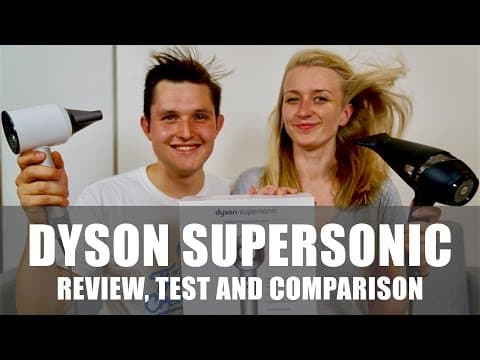
Dyson Supersonic Hairdryer - Review, Test and Comparison
Sander Saar reviews and tests the £300 Dyson Supersonic hairdryer, comparing it against a £100 GHD hairdryer. He begins by outlining Dyson's history of redesigning everyday appliances and the four issues the Supersonic aims to address: bulkiness, heat damage, noise, and slow drying. He unboxes the device to show its diffuser, smoothing nozzle, styling nozzle, and heat mat, then examines its 27-millimetre handle-mounted motor, air multiplier technology, control buttons, and magnetic attachments. In a split-screen drying test on his short hair and his partner's long hair, he compares both models across four areas. The Dyson Supersonic dried hair 20 to 25 per cent faster, taking 1:30 compared to 1:50 for short hair and 3:25 compared to 4:26 for long hair. Sander also notes that the handle-mounted motor makes it more balanced, easier to manoeuvre, and better for travel, while its sound is higher-pitched than the lower-pitched GHD dryer. He reports that the conventional dryer and its nozzle burned their skin, whereas the Dyson did not and left long hair smoother. He concludes that the Dyson Supersonic meets its claims, particularly regarding comfort and heat protection, and argues that its £300 cost can be justified over five or more years of regular use.
Watch on AgentTVAsk about this video
Chapter summaries
Introduction to Dyson and the Supersonic hairdryer
Sander introduces Dyson's history of reinventing everyday products, from the ballbarrow and cyclone vacuum cleaner to bladeless fans and hand dryers, before outlining the four problems the Dyson Supersonic aims to solve: bulkiness, heat damage, noise, and slow drying.
On screenA man in a white t-shirt sits on a grey sofa against a plain white wall, speaking and gesturing to the camera. He holds up a white Dyson Supersonic product box, followed by animated title cards. As he speaks, floating graphics of traditional and Dyson-reinvented wheelbarrows, vacuum cleaners, fans, hand dryers, and hairdryers appear on either side of him with comparison text.
Unboxing and hardware overview
Sander unboxes the Dyson Supersonic hairdryer, showing the diffuser, smoothing nozzle, styling nozzle, and heat mat. He then examines the hardware, highlighting its build quality, handle-mounted 27-millimetre motor, air multiplier technology, control buttons, and magnetic attachments.
On screenAn overhead view over a grey sofa shows hands opening the white Dyson Supersonic box and removing the diffuser, nozzles, dark grey mat, and silver-and-grey hairdryer from the inner tray. Close-ups show a hand rotating the hairdryer, pressing the handle buttons to light up the indicator dots, and attaching the magnetic nozzles and diffuser.
Real-life drying test against a GHD hairdryer
Sander sets up a real-life comparison between the £300 Dyson Supersonic and a £100 GHD hairdryer, testing both on his short hair and his partner's long hair to evaluate speed, noise, heat, and comfort.
On screenThe man sits on the grey sofa speaking to the camera, followed by an overhead shot of hands holding the white-and-silver Dyson hairdryer and a black GHD hairdryer side by side. A split-screen view then shows the man, and later a woman with long blonde hair, drying their hair simultaneously with both dryers while a central timer counts up and sound labels appear.
Drying speed comparison
Sander introduces the four promises Dyson makes and compares drying times, noting the Dyson Supersonic was 20 to 25 per cent faster.
On screenIndoors against a plain white wall, a man with short brown hair sits centred on a grey couch in a medium shot, wearing a white T-shirt with blue lettering reading "Thank You Creativity", a black watch on his left wrist, and a small lavalier microphone clipped to his shirt. Speaking to the camera and gesturing, he holds up a white and grey Dyson hairdryer with a dark nozzle in his right hand and a black conventional hairdryer in his left hand for comparison. Grey on-screen text appears on the left and right sides of the frame displaying drying times as "Short 1:30", "Long 3:25", "Short 1:50", and "Long 4:26", with "20-25% less time" shown on the lower left. The camera later moves to a closer medium close-up as he continues holding both hairdryers and turns the white dryer to show it while speaking.
Comfort and portability
Sander explains that putting the motor in the handle makes the Dyson more balanced, easier to maneuver, and better for travel.
On screenIndoors, a man in a white T-shirt with blue print sits on a grey couch against a plain white wall, speaking to the camera. He holds a white and silver hair dryer in his right hand and a black hair dryer in his left, gesturing with them, turning the white and silver dryer in his hand, and briefly raising it near his head. The framing shifts between medium shots and medium close-ups, and the text 'Thank You Creativity' and 'dyson' appears on screen.
Noise and pitch comparison
Sander compares the sound of both dryers, demonstrating that the Dyson is higher-pitched while the conventional dryer is lower-pitched.
On screenIndoors, a man sits on a grey fabric couch against a plain white wall, wearing dark trousers, a white t-shirt with blue graphic lettering, and a small black microphone clipped to his shirt. Shown in medium close-up and wider medium shots, he speaks to the camera while holding a white and silver hairdryer with a grey nozzle in his right hand and a black hairdryer with a flared nozzle in his left hand at chest height, moving, turning, and gesturing with both. The text "Thank You Creativity" appears on screen.
Heat damage and hair smoothness
Sander notes that the conventional dryer and its nozzle burned their skin, whereas the Dyson did not and left long hair smoother.
On screenA man with short brown hair sits on a grey sofa against a plain white wall, wearing a white t-shirt with blue lettering reading "Thank You Creativity", a black wristwatch, and a clipped microphone. Holding a white and silver hairdryer in his right hand and a black hairdryer in his left, he raises the black hairdryer near his head and rotates both dryers to display their sides and circular rear openings while speaking to the camera. An overhead close-up shows two hands holding the two hairdryers nozzle-to-nozzle over a grey surface, with white packaging boxes and a grey circular attachment in the background alongside the text "dyson". The shot returns to the man on the sofa turning both hairdryers, followed by a woman with long blonde hair in a grey t-shirt sitting on the same sofa, using both hands to lift, separate, and inspect strands of her hair in front of her face.
Conclusion and value verdict
Sander concludes that the Dyson Supersonic delivers on its promises, particularly in comfort and preventing heat damage, and argues that its £300 price can be justified over five or more years of regular use before signing off.
On screenThe man sits on the grey sofa against the plain white wall, holding both hairdryers and gesturing with them as he speaks to the camera. The video ends with a full-screen animated title card featuring red, black, and yellow diagonal bars over a textured blue-grey background.
Transcript
Hi everybody, I'm Sander and I believe in technology. Many say that there is no need to reinvent the wheel. Well, I'm passionately following the people who do just that. James Dyson with his company has been doing that since 1974. This time they're trying to reinvent the hair dryer. Let's take a closer look.
Dyson is not new to the world of completely rethinking technologies that seem final to many people. Think about the 1970s where he reinvented the wheelbarrow using a ball, calling it a ballbarrow, and that can be used on many other surfaces rather than the traditional wheelbarrow. After that, something that many people use in their homes is also the vacuum cleaner that he reinvented using a cyclone technology, meaning that it's not using any replaceable bags, so it remains as powerful and efficient from the day you bought it.
Another well-known invention from Dyson is E are the bladeless fans, which are using an air multiplier technology to make them more quiet and more efficient. And the most recent invention from Dyson are the hand dryers that you can see in many public places where you just slide your hands in and out a few times and they're completely dry. This time Dyson is trying to change the hair dryer industry. There are 4 problems that they're trying to solve with the Supersonic hair dryer. First of all, the existing solutions are bulky and heavy and unbalanced.
Secondly, they burn your hair because they go at really high temperatures. Thirdly, they're really loud. And fourthly, they take a long time to dry their hair. And also, the existing hair dryers haven't changed from the 1960s, and it took Dyson about 4 years of research and development before they brought out the Supersonic hair dryer. Let's unbox the Dyson Supersonic hair dryer, take a look at the hardware, and then also do a real-life test against a conventional hair dryer with my short hair and also with my partner's long hair.
The Dyson Supersonic hair dryer comes in a fairly plain box of just white and the hair dryer itself on the front. On the back, they're definitely trying to impress you with all the technology and engineering that has gone into making the hair dryer. So let's take a look at what's inside. First of all, they have the diffuser, then there's more nozzles here, so I guess that's the smoothing nozzle and that's the styling nozzle that it comes with.
Then there's a heat map here, which I guess you can just slide out and you can put your hair dryer on it. And then there's the hair dryer itself. Looking at the hardware, when you take the Supersonic hair dryer in your hand, you can definitely feel that it's made from high-quality plastic. On the hair dryer itself, there are not that many buttons. First of all, you have the on and off power button. Just below that, you have a cool button, and on top of it, you have 2 buttons, one to change the fan speed and the other one to change the temperature.
The hair dryer itself has got a built-in motor into the handle to allow better balance rather than be top-heavy. It has a tiny motor of just 27 millimeters in diameter in the handle that is turning 13 liters of air per second, which is about 6 times faster than any conventional hair dryer because it's using an air multiplier technology. You can attach the nozzles using the magnetic technology, which will keep them really well.
You have a styling nozzle, smoothing nozzle, and also a diffuser that you can change very easily. The hardware itself also has a built-in heat control that should eliminate your hair damage, and it ultimately should be more quiet than a conventional hair dryer. But it's hard to say if any of that is true without the real-life test. So in this test, we're going to do 2 things. Both of us, myself and my partner, will be drying their hair with a Dyson Supersonic hair dryer and also with a conventional hair dryer, which is also higher-end from GHD.
That is about £100 in cost, and Dyson itself costs about £300. And after this, we'll see whether it's actually faster, is it more quiet, does it not burn your hair, and is it actually more comfortable to hold. So let's take a look at the test.
What did we learn from the test, or how well Dyson is delivering on those 4 promises they're making against the conventional hair dryer, the industry that is more than 70 years old and they're trying to change? First of all, let's talk about time. Dyson says that it takes less time to dry your hair with Dyson than with conventional hair dryer. In our test that is definitely not scientific and just, well, from our own opinion, it took about 20 to 25% less time, which is about instead of 5 minutes will take you 4 minutes.
I don't think that's enough to justify the price difference of £300 versus £100. The second thing that Dyson promises is comfort, and we definitely both agree that Dyson putting their engine or the motor into the handle Definitely feels more solid and balanced in hand than the top-heavy. It also, because of the size, it's much easier to get into your hair. Besides Dyson being smaller, it's much easier to take that with you when you go to travel.
The big one would never get in unless you buy the specific travel ones. Thirdly, what Dyson promises is noise, that it's going to be less noisy than a conventional hair dryer. We didn't find them, neither of them, too noisy, but there's this different pitch where Dyson is really high-pitched, then the conventional hair dryer is much lower-pitched, and you can hear the difference. You can have easier conversation over Dyson than a conventional, but again, that's not that much of a difference.
Fourth area, which is the most important area, is the promise that they're not going to damage your hair and they're going to be comfortable using while you're drying your hair. We both found the conventional one really burning your head, and you can feel it from your skin after you've dried your hair that they've actually really irritated your skin. And neither of us had that feeling while using the Dyson hair dryer. By the way, both running at full steam and the full temperature that comes out of these hair dryers.
Also, the nozzle gets really hot on the conventional hair dryer, and when it touches your face or any part of your skin, then it really burns. And that wasn't the case with Dyson hair dryer. In addition to the burning, my girlfriend also said that the Dyson hair dryer left her hair much more smoother rather than leaving them in those bulks that than the conventional hair dryer, which is something that I didn't feel because I have short hair, but something that you should consider for your long hair. Overall, Dyson has delivered on all the 4 promises they made, in some areas exceeding more than we actually thought.
It's not going to save you so much time, it's not going to be super quiet for sure, but it's definitely going to be more comfortable in hand and it's not going to damage your hair as much, which I think is the biggest promise that Dyson is making and also delivering on. Can you justify a £300 price or a $400 price over a more conventional, a high-end one, for example, that you can get from £50 to £100, which is about $150 to $200? We think you can.
Depends how often you use it, because if you cost it down per cost per use, then ultimately the longer you can use it, let's say if Dyson would last us 5 or more years, then there's going to be ultimately almost no cost difference. So we're going to use Dyson and not going to use the conventional hair dryer anymore. Go out, test them. In order to understand the difference and the value, whether you can justify the £300 price point. Thank you very much for watching this video on Dyson Supersonic hair dryer in comparison with a conventional hair dryer.
Please answer a question here on your right by clicking on that I button, whether you think you would justify the £300 price point for Dyson hair dryer and you would consider getting one. Thanks again for watching, and I hope to see you in the next video.