











Best eReader - Kindle Oasis 2 Review and Comparison with 2016 Kindle Oasis
By Sander SaarPublished Updated Length
Loading YouTube player.
Best eReader - Kindle Oasis 2 Review and Comparison with 2016 Kindle Oasis
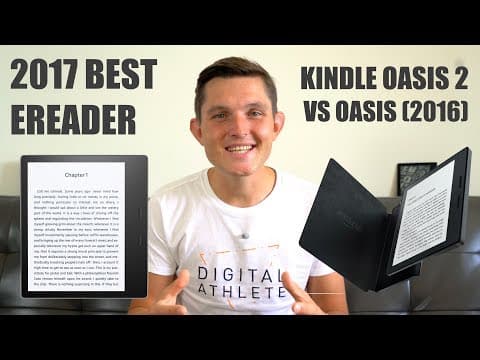
Sander Saar reviews the 2017 Amazon Kindle Oasis 2 and compares it with the 2016 Kindle Oasis. Using side-by-side demonstrations on a wooden table, he covers the physical changes, including the larger 3.4-millimetre-thin body, the increase in weight from 131 grams to 194 grams, and the switch from a plastic to an aluminium back. He examines the hardware upgrades, which include a 7-inch 300 ppi display (up from 6 inches), an automatic ambient light sensor, 12 LEDs instead of 10, and a 1 GHz processor. The video demonstrates the device's water resistance, rated for 2 metres for up to 60 minutes, by pouring water over the screen, and notes that while the external battery cover connection was removed, battery life remains similar. Sander also shows how to pair a Bluetooth speaker to use the new built-in Audible support and switch between listening and reading, and mentions the storage increase from 4 GB to 8 GB or 32 GB. Finally, he compares the $249 base price with the previous $289 model and the Kindle Paperwhite, concluding that the Kindle Paperwhite offers the best value for most people while the 2017 Kindle Oasis is the best e-reader overall, and advises using Prime Now to avoid backorders.
Watch on AgentTVAsk about this video
Chapter summaries
Introduction to the Kindle Oasis 2
Sander Saar introduces the 2017 Amazon Kindle Oasis 2 and compares it with the 2016 Kindle Oasis, noting his history with Kindles, the benefits of distraction-free e-ink reading, and the addition of Audible and Bluetooth support.
On screenA man in a white DIGITAL ATHLETE t-shirt sits on a black tufted leather sofa in a bright room with two small framed pictures on the wall behind him, speaking and gesturing to the camera. A title card introduces the review, followed by overlaid images of Kindle e-readers and logos for Audible and Bluetooth.
Form factor, weight and aluminium build
Sander compares the physical dimensions, weight and materials of the two devices, noting that the new Kindle Oasis is larger yet still 3.4 millimetres thin, weighs 194 grams compared to 131 grams, and features an aluminium back instead of plastic.
On screenThe presenter speaks on the sofa before cutting to an overhead view of two black e-readers on a wooden table. Hands separate the devices side by side, flip them over to show their backs, and tilt them to compare their thin profiles, with on-screen callouts for dimensions and weights.
Larger 7-inch screen, lighting and processor
Sander discusses the upgrade from a 6-inch to a 7-inch 300 ppi display, the addition of an automatic ambient light sensor, 12 LEDs instead of 10, and a 1 GHz processor, noting that screen refresh rate still limits speed.
On screenAn overhead shot shows two black e-readers on a warm brown wooden table, with the larger left device displaying rolled newspaper tubes in black and white and the smaller right device displaying overlapping metal letter blocks. White annotation lines appear above each screen, labelling them as 7 inches and 6 inches. The video cuts to a man with short brown hair wearing a white t-shirt printed with DIGITAL ATHLETE, a black watch, and a ring, seated centred on a black tufted leather couch against a plain light wall with two small framed black-and-white pictures behind him as he speaks to the camera and gestures with both hands. Returning to the overhead view of the wooden table, hands tap the top of both e-readers, labelled on screen as Sander's 3rd Kindle and Sander's Kindle Oasis, to open settings panels above their library screens of book covers. A finger slides the light brightness control on the right device and then on the left device, before the scene briefly returns to the man speaking and gesturing on the couch. Back at the table, hands hold, swipe, and tap the two e-readers, the left with a light-coloured edge and the right all black, switching them from black-and-white images to a library grid of book covers, and then tapping the left device to open a plain white book page with centred text. Finally, a single black e-reader with a light edge sits alone on the wooden table displaying the rolled newspaper image while a stream of water is poured onto the right side of the device, splashing and pooling on the table and leaving droplets on the screen and bezel.
Water resistance and battery life
Sander demonstrates the new water resistance, rated for 2 metres for up to 60 minutes, and explains that achieving this meant removing the external battery cover connection, though battery life remains similar.
On screenHands lift a wet black e-reader covered in water droplets from a wooden table and hold it close to the camera. The screen initially displays a rolled-newspaper image before a tap switches it to a library layout labelled Sander's 3rd Kindle, showing book covers under headings including MY LIBRARY and MY READING LISTS. Next, two e-readers lie face-down side by side on the wooden table, a silver one on the left and a black one on the right, each with an amazon logo on the back and a central hinge strip with small indicator dots. Hands gesture towards the hinge areas and lift the black cover attached to the black device to unfold its interior panels. In a top-down close-up in indoor light, hands, one with a silver ring, hold a black Kindle displaying a grey collage of large letters, close its black case bearing an embossed amazon logo, and set it down beside the silver Kindle.
Audible, Bluetooth audio and storage
Sander highlights the built-in Audible and Bluetooth integration, demonstrating how to pair a Bluetooth speaker to listen and switch seamlessly to reading, and notes the storage increase from 4 GB to 8 GB or 32 GB.
On screenHands hold a small round light-grey Bluetooth speaker beside the Kindle on the wooden table, then navigate the Bluetooth settings, Audible player and book text on the e-reader screen. Later, the presenter speaks on the sofa with on-screen storage graphics.
Pricing and value comparison
Sander evaluates the $249 base price of the new Kindle Oasis compared with the previous $289 model and the Kindle Paperwhite, concluding that the added functionality helps justify the cost.
On screenThe presenter sits on the dark leather sofa speaking and gesturing to the camera, with white price callouts appearing briefly on both sides of the frame.
Final verdict and buying tips
Sander concludes that while the Kindle Paperwhite remains the best value for most people, the 2017 Kindle Oasis is the best e-reader overall, advises using Prime Now to avoid backorders, and signs off.
On screenThe presenter speaks and gestures from the dark leather sofa, giving a thumbs-up and waving goodbye before the video cuts to a black end card with white text prompts.
Transcript
Hi everybody, I'm Sander and I believe in technology. Besides all of the race going on between smartphones, tablets, and computers, also e-readers seem to be making great progress. In this video, let's take a look at the 2017 Amazon Kindle Oasis 2 and compare it to the last year Kindle Oasis. Let's take a closer look.
I've used Kindles for a while, from the original one to the Paperwhite to the Voyage and Oasis since last year. And I find myself more and more turning away from smartphones, computers, and tablets in order to allow myself a distraction-free downtime when reading. And e-readers have been doing a great job. There's no notifications, there's no flickering screen, there's e-ink displays, and also there's no apps and no websites, or if they're there, they're very slow, so you don't want to use them.
Even though not much seems to be improving in that phase and everything seems to be kind of ironed out and worked out and it's a very mature industry, I think this year Amazon made a completely new functionality for the device by bringing on audiobooks and Audible support, where you can read and listen simultaneously on the same device and have everything synced up, similarly as has already been available on iOS and Android Kindle apps before. So let's see what they have changed from form factor to the screen to the power and also functionality of these devices.
First of all, let's talk about the form factor. This year's Kindle Oasis is 0.7 inches higher and 0.8 inches wider, so it's significantly, significantly bigger device when you hold it, but at the same time they managed to keep it at the thinnest point still 3.4 millimeters, which is very impressive. On the other hand, they had to increase the weight about 50% and now weighs more than 190 grams. I mean, it doesn't make a big difference, but you can feel it when you compare them side by side.
At the same time, they're also offering better materials. Instead of a plastic back, it now has a nice aluminum back, which also besides the looks brings better durability over time. All of these changes are there to accommodate the larger screen. Instead of 6 inches, it's now 7 inches. I wish they would have downsized the form factor as well and not have large bezels, but I guess that's what they had to do in order to keep it still very thin.
The screen itself is high resolution but still provides the same clarity and 300 pixels per inch as also do the Paperwhite and Voyage. On the other hand, from the last year Voyage, they're bringing on the automatic ambient light sensor, which automatically adjusts the brightness of the screen depending depending on the environment you're in. And they've also added additional LEDs to cover the bigger screen, so now instead of 10, they have 12 LEDs lighting up the display.
The difference also comes from the processor, where they've now accommodated a 1 GHz processor. But to be honest, I think it's more to turn around those pixels rather than give you more speed. Maybe it feels about 20% faster when you're doing all the tasks, but really that also comes down to the refresh rate of the screen, which hasn't changed over time. So the speed change is not really noticeable. Another difference from hardware side is that it's now water resistant.
What it means is you can take it to your bath or pool with you and not worry about it. You can keep it underwater 2 meters for about 60 minutes, so that should give you plenty of coverage in order to allow any kind of environment. But in order to bring that water resistance, they had to take away the ability to connect external covers give you much longer battery life. I'm still due to test. It seems about the same battery life on both of them.
They just say it's weeks, but at the same time, I acknowledge that having an extra battery with it will give you more comfort during longer travels. The major selling point for me on the functionality side was the integration between Audible and Kindle, which has been available on iOS and Android devices for a while now, where you can be listening to something on an audio and then continue reading it in a Kindle app. But it wasn't supported on Kindle devices before, as none of them had Audible built in.
Now you can do that, and I found it very useful. I use the Kindle at home, and it's connected to the Bluetooth speaker, so it's playing out loud with any notification dings and dongs and syncs up perfectly with my Kindle reading experience as well. And to be honest, more and more of my reading now is done through audiobooks, so I really enjoy that integration. I see it as a vital part of the evolution of e-readers. For audiobook support, Amazon also had to increase the storage and memory on these devices.
From 4 gigs last year, the minimum is now 8 gigs, and you can expand it up to 32 gigs. 8 gigs will give you room for about 35 audiobooks, so that should be plenty for you to start with. With all of that functionality, there's still a hefty price attached to it. Even though they managed to do it for lower, from $289 to now $249 for the Kindle Oasis base model, it's still double the price from the Kindle Paperwhite, which does at least half of what it did before.
But I think for now you can justify it as you actually have additional functionality and performance compared to the other Kindles on the market. So to conclude, unless you really want the larger screen, which I appreciate a lot, or the water resistance, or the built-in Bluetooth for Audible support, I still think that Paperwhite for half of the price is still the best option out there. It gives you the same quality of the screen and also similar performance.
By the way, later this year Audible support will be coming to the original Kindle as well and not the Paperwhite. So Amazon is playing the kind of game here which I'm not a huge fan of. But for now, I think Amazon Kindle Oasis 2017 is the best e-reader out there today. From the metal build quality to an amazing larger screen and built-in audio and Bluetooth support through Audible, It's a great package. If you're looking to buy it and you want to get it quickly instead of waiting 2 to 4 weeks, which is the backorder at the moment on Amazon, if you live in a country where there's Prime Now available, just order it through there.
They have it in stock and you can have it in 2 hours. Thank you very much for watching. I hope you enjoyed this quick review and comparison with the Kindle Oasis. If you did, please give it a thumbs up. Leave your comment below on what you think is the best e-reader and what you value, whether it's a worthy upgrade. And also subscribe to the channel in order to see future videos. Thanks again, and I hope to see you next time.