









92% goals fail - here’s a system that might help, inspired by Daniel Pink
By Sander SaarPublished Updated Length
Loading YouTube player.
92% goals fail - here’s a system that might help, inspired by Daniel Pink
This video presents Year Designed, a free digital planning tool inspired by Daniel Pink, Tim Ferriss, and Chris Williamson. The system guides users through an identity snapshot, past year reviews, goal setting, pre-mortems, friction design, and theme selection. It also provides calendar reminders, a downloadable plan, an AI wallpaper, and direct exports to Claude, ChatGPT, or Gemini for accountability.
Watch on AgentTVAsk about this video
Chapter summaries
Why New Year goals fail
The presenter highlights that 92% of New Year's resolutions fail and explains that a successful year requires designing a system rather than relying purely on motivation.
On screenA man speaks directly to the camera in front of research statistics and an abstract from a PubMed study on resolution success rates.
Introducing the Year Designed tool
The host introduces Year Designed, a free digital planner built on Daniel Pink's framework with ideas from Tim Ferriss and Chris Williamson.
On screenThe presenter stands in front of the YearDesigned.com website, a video clip of Daniel Pink, and pages of the digital workbook.
Identity snapshot and past year review
The user starts by capturing their best self through three descriptive words, followed by evaluating the past year's top wins and biggest regrets.
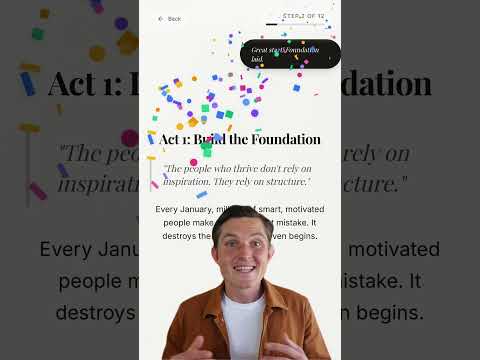
On screenThe presenter demonstrates filling out the interactive form on Year Designed, showcasing the Three Words exercise and the Your Biggest Win step.
Setting wins and running a pre-mortem
The workflow prompts users to define three measurable wins and perform a pre-mortem to anticipate and counter potential failures in advance.
On screenThe host talks while pointing toward the Regret Review screen and the Pre-Mortem failure mode input fields in the application.
Choosing a theme word and designing friction
The user chooses a guiding theme word for their year and implements friction strategies to discourage bad habits while simplifying good ones.
On screenThe presenter reviews prompt screens for adding failure preventions, selecting a theme word from a list, and setting up habit friction.
Reviewing takeaways, reminders, and phone wallpaper
After completing the planning steps, the tool produces a summary document, weekly review calendar reminders, and an AI-generated vision wallpaper.
On screenThe screen displays key takeaways, an interface to add recurring calendar events, and a colorful custom mobile phone wallpaper.
Exporting to AI accountability partners
Users can export their complete plan directly into LLMs like Claude, ChatGPT, or Gemini to serve as personalized accountability coaches.
On screenThe presenter stands in front of AI integration options for Claude, ChatGPT, Gemini, and Grok, followed by an AI chat review prompt.
Privacy, the Eisenhower quote, and wrap-up
The speaker emphasizes that all data stays private in the browser, quotes Dwight D. Eisenhower on the importance of planning, and provides the website link.
On screenThe presenter talks with app screens in the background, transitions to a quote card of Dwight D. Eisenhower, and concludes over the YearDesigned.com URL.
Transcript
Every January, millions of smart and motivated people set their goals, and 92% of them will fail. A better year isn't something you wait for, it's something you design a system for. I built Year Designed, a free digital version of Daniel Pink's planning workbook with key techniques from Tim Ferriss and Chris Williamson baked in. Most planning workbooks give you a blank page, but Daniel Pink's framework is different. It provides exercises that reveal your truth and then builds systems around to support it. Start with identity snapshot, 3 words that describe you at your best, and then define what helps you get to your best.
Then a quick past year review Tim Ferriss style, your biggest wins and regrets, because regret isn't weakness, it's an instruction on what to change. Then define 3 measurable wins. Run a pre-mortem on each one of them, identifying how you will fail before you do. Choose a theme word, your compass for the year, and then design friction, Chris Williamson's method for making good habits easier and bad ones harder. When you're done, download your complete plan as a document, set up calendar reminders for weekly reviews or quarterly check-ins if you want, and get a generated AI wallpaper featuring your theme word and commitments so your plan shows up every time you unlock your phone.
Here's the key: one-click export your plan Claw, ChatGPT, Gemini, or your favorite LLM. Use it as an accountability partner all year, someone who actually remembers what you said you wanted. It's free, no account, fully private. Your data stays in your browser only. While your plans might also fail, having systems and direction in place helps. Like Eisenhower said, plans are useless, but planning is everything. Check out yeardesign.com, and I hope you'll find it useful.