Sander Saar, founder of AgentCDN, making videos work inside AI





Creating
Shorts

Reviews

The Future of Netflix: The End of an Era
Jun 30, 2022

Which apps will Apple axe? WWDC 2022 explained
Jun 11, 2022
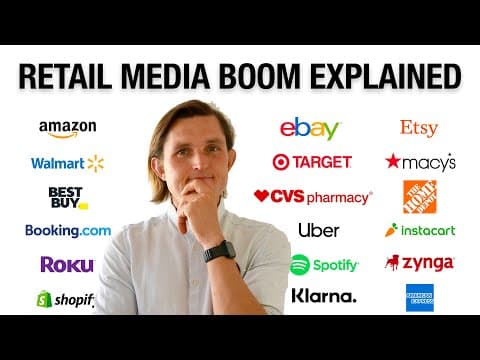
Retail Media Boom: Why Companies Build Ad Networks
Jun 3, 2022

WYSK: Microsoft Build - Meta Conversations - Stripe Sessions - Instagram TED Talk - Sequoia Report
May 27, 2022

How Synthetic Media will change Hollywood? with AI, Digital Humans, Voice Cloning + Synthesia Demo
Sep 16, 2021

Why Audio is Winning: Clubhouse & Facebook's Plans
May 17, 2021
Related videos · 8 videos
Shorts · 2
Videos · 6
The Future of Netflix: The End of an Era
Jun 30, 2022
Which apps will Apple axe? WWDC 2022 explained
Jun 11, 2022
Retail Media Boom: Why Companies Build Ad Networks
Jun 3, 2022
WYSK: Microsoft Build - Meta Conversations - Stripe Sessions - Instagram TED Talk - Sequoia Report
May 27, 2022
How Synthetic Media will change Hollywood? with AI, Digital Humans, Voice Cloning + Synthesia Demo
Sep 16, 2021
Why Audio is Winning: Clubhouse & Facebook's Plans
May 17, 2021
Apps
Analysis
Netflix coming to the end of the road: What's next for Netflix?
Jun 30, 2022
Retail Media Boom: Why is every company building an ad network?
Jun 3, 2022
What You Should Know? Ep. 1: Microsoft Build, Meta Conversations, Stripe Sessions
May 27, 2022
How Synthetic Media will change Hollywood: AI, Digital Humans, Voice Cloning
Sep 16, 2021
Why audio is driving growth: Clubhouse learnings + Facebook's plan to win
May 17, 2021
Articles

Retail Media Boom: Why Companies Build Ad Networks
Loading YouTube player.
Retail Media Boom: Why Companies Build Ad Networks
Jun 3, 2022 · 15:06
This video examines why diverse companies, from airlines to retailers like Amazon and Walmart, are establishing their own advertising networks. It details how platform privacy changes such as Apple iOS 14, regulatory measures like GDPR and CCPA, and macroeconomic pressures drive businesses toward first-party data monetization. Finally, the presentation compares the competitive impact on multinational brands versus small businesses, alongside shifts affecting social platforms, ad tech, and agencies.
Chapters
- 0:00
Introduction to retail media growth
The host introduces how companies across various sectors are expanding into retail media and building ad networks that outpace traditional digital giants.
- 0:10
Every company is building an ad network
An exploration of how apps and services ranging from delivery platforms to airlines and retailers like Walmart and Amazon have integrated ad placements.
- 2:34
Privacy changes driving the shift
A breakdown of how operating system restrictions like iOS 14, cookie deprecation, privacy regulations, and rising consumer ad blocker usage have altered digital advertising.
- 5:39
Macroeconomic climate and supply constraints
An analysis of the economic slowdown, inflation, falling tech valuations, and supply chain constraints motivating retailers to optimize revenue streams.
- 6:39
The retail media growth opportunity
Examining how Amazon's closed-loop funnel drove over $31 billion in advertising revenue and boosted overall retail operating profitability.
- 8:46
Implications: Multinational brands vs. SMB brands
A discussion on why large multinational retailers gain an advantage through first-party data and larger basket sizes while small direct-to-consumer businesses face challenges.
- 11:27
Implications: Social platforms vs. ad tech and agencies
Analyzing the struggle of social platforms against privacy limitations, the resurgence of ad agencies, closed-loop social commerce, and Apple's ad growth.
- 14:52
Conclusion and closing remarks
The host wraps up the video, invites viewers to share their thoughts in the comments, and asks them to like and subscribe.
Transcript
- 0:00
Hi, I'm Sander, and I'm really excited to explore with you how absolutely every single company is becoming an ad network and how the retail media is growing faster than Facebook or Google. We're used to seeing ads on social media, on Instagram and YouTube, and as well as on search like Google Search and Bing, as well as news outlets like The Verge. But now ads are absolutely everywhere. I went to a petrol station and Chevron served me an ad for a supermarket, Albertsons.
- 0:25
I then opened an app in order to plan my trip to a conference, Booking.com. Almost the first 2 listings the first screen were all ads. I then opened a credit card app. I was seeing offers there for third parties. I then tried to order food on Uber or Instacart, and you see ads served up left, right, and center. Even an airline, an American airline, has become an ad network. They were serving ads in order to unlock free Wi-Fi on board.
- 0:50
Of course, you know, when you tell your friend to download an app from the App Store, the first one is never the right one because it's an ad. And now Apple is also asking you to be notified when they have updates or recommendations for you. When I got to the conference, the first load screen that loaded was an ad. So even a conference holder is becoming an ad network. And you know, when you go to Walmart, you type in water, none of the first are going to be good for you. They're going to be something that is sponsored, something that somebody has paid for.
- 1:16
It's an ad. On Amazon, you type in water and you see content about it, the trending products, but they're all sponsored. Somebody is paying to be there. When you then open the Amazon Fire TV and want to watch something, Oops, almost all of it is Prime Video or Freevee content that you see on the front screen, or Roku for that matter, who's doing the exact same thing, pushing content, Roku Originals. We'll see that everyone, absolutely everyone from the e-commerce marketplaces like Amazon and eBay to the big box mass retail like Walmart and Target, to the category-focused retailers like Best Buy and CVS, and to travel companies that we've seen like Booking or Uber, to the entertainment platforms like Roku.
- 1:54
Absolutely everybody has become an ad network. So if you switch those logos to B2B logos, you see that they have those brands like Amazon Ads, eBay Ads, Walmart Connect, Roku Advertising, Shopify Audiences, whatever you call them. Their whole goal is to bring together those 2 big worlds, truly focus, bring together the commerce and the media to help you buy something on the same platform when you consume that.
- 2:20
And this is not new. I'm taking this idea from Eric Schaeffer, who who has a Mobile Dev Memo content. He's talking about that a lot on his blog, how everything is an ad network, but why, why is that happening now? I believe there's 3 key changes in the world that are driving it. Number one is the privacy change from the industry platform and user point of view, the macroeconomic climate, but also how, what kind of growth opportunity and new business model this unlocks.
- 2:49
So let's dive into each one of them to tell you more about it. Number one is the platform's focus on privacy. We saw that in 2017 Safari introduced a blocker that was tracking the advertiser IDs, then the Efficient Tracking Protection from Firefox afterwards, then Chrome in 2018 announced the cookie deprecation which they've not completed, they're expected to complete that by 2023, and the biggest change overall was the Apple iOS 14 where the identifier for advertisers was deprecated with the iOS 14 update.
- 3:26
And then Google announced Privacy Sandbox to find new ways to also deprecate the Google Advertiser ID from their services by about 2024, in about 2 years. So we see a lot of this focus around privacy protection and tracking protection from the operating systems to application levels. And that's also coming from because a lot of the politicians, more predominantly European Union with the GDPR, General Data Protection Act, as well as the US states like Utah, as well as California, who started with consumer protection acts that are blocking companies' access without explicit consent.
- 4:05
And that has also changed user behavior. Users are more and more using now ad blockers and blocking trackers by default. So if you even don't know on Safari that by default you're actually not letting cross-site tracking happen, or if you're using a browser like Firefox or Brave, those things are on by default. Also, consumers are more and more using VPN services. That means that the IP of the user is not necessarily seen. So iCloud has got this feature called Private Relay that's built in.
- 4:33
And also when you're a Google One subscriber using any of their paid services, cloud services, you get free VPN from Google. So they control the traffic that goes through their services. And the third area is hiding your email, hiding your identity that used to bring everything together using Hide My Email that automatically generates new email for every service that you sign up to. And users are using that more and more. You see the ad blocking growth rapidly, almost a third to 40% depending on the region utilizing that, as well as the VPN growth having doubled in the last 3 years as well.
- 5:06
So this is massive growth in the user adoption in these services as well. We also see that the challenges now that come from that is number one, you cannot do any more one-on-one targeting because you don't have that identity across the board. That has also increased the advertising cost rate in Google Search as well as Facebook services because they can't be as effective in matching you with the result of the ad, as well as there's limited measurement because there's no unified identifier across the services.
- 5:36
And that has really changed the game. In addition to that, we mentioned there is macroeconomic slowdown. We had the first quarter of declining growth and we're expected to have a second quarter of declining growth, GDP growth as well. We've seen the highest inflation almost in the last 40 years that the economy has seen. Also, we see the companies massively highly evaluated, highly valued, and they are not being able to match their valuations because they're getting too far in the future and not based on the economics today.
- 6:08
In addition to macroeconomic side, there is a supply chain constraint. We've seen a 40 times increase in the cost of shipment of one container that used to be $500 from China to the US. Now it's more than $20,000, between $15,000 and $20,000. In addition to the shipping time has also increased from 50 days to 120 days. And you see how the big box retailers like Walmart plan to invest $14 billion to build their own vertical logistics, as well as Target, who said they're investing $5 billion in their own operations.
- 6:40
And you could see more and more of those investments coming from most of the other large big box retailers. And who's one of the biggest winners of that? Obviously the poster boy of that is Amazon with Amazon Advertising, where they managed to close the whole loop on one single platform, all the way from awareness, watching Prime Video or watching Freevee or visiting IMDb or watching Twitch content or going to Whole Foods or using Alexa or Ring or Aero or any of the services to understand your interest and the desire and then also bring you the awareness, actually show you the ad spots.
- 7:14
And Amazon Ads is what brings it all together, all the way to the action, to the purchase on their platform. That's why we've seen in the last year almost 60% increase in Amazon Ads services, now reaching more than $31 billion in 2021. If you put that in perspective, that's more than YouTube, that is $28 billion, or even more than YouTube and Pinterest combined. And Twitter is just $5 billion, if you put that in perspective.
- 7:40
So Amazon has truly minted themselves as the 3rd largest player in the ad space. And it's interesting that it's not just a massive economic growth opportunity for Amazon, but it's also relevant for profitability. Of course, it brings them scale, they have massive first-party data advantage. But if you look at those 2 graphs here on the right, that's from Luma and through their Digital Media Summit, which I'm also going to link down below.
- 8:05
You should check out their videos, which are super useful and valuable in the space, they showcase those 2 lines. The orange one is Amazon with their ads revenue or ads income and blue one without the Amazon ads income. And you can see that Amazon wouldn't really have been profitable even more than the last 10 to 12 quarters if they didn't have advertising in the space. So you can see that it's a really high margin business estimated to be a 35% contribution.
- 8:32
That's why you see the retail media really exploding onto the big scale and you'll see a very healthy, almost a 40% average annual growth across forecasted from the last couple of years all the way to 2024. So, but what are the implications of all of that? This being obviously a massive shift from privacy side, being a massive opportunity from revenue side, and also helping to counter all of the macroeconomic climate.
- 8:59
So who are the winners and losers? One of the winners is definitely going to be the big box retail as opposed to the small and medium-sized business. And I know it sounds cliché because Facebook has been talking about it a lot, but I truly believe this to be the case. And why, why is that? We see that even over the last couple of quarters that while Walmart has been growing fast and is showing a strong performance in the US, you see somebody like Glossier, who's been the poster boy of the direct-to-consumer brand, laying off 80 people this year, not really showing any new openings in the company and losing their traction also on some of their key platforms like Instagram.
- 9:36
And that is happening for a couple of reasons. Number one is that those companies are heavily reliant on the third-party data they got from Facebook and Google. In addition, they're also heavily reliant on the direct response performance advertising, which has to have those trackers that are connected across the board. In addition, they have smaller basket size and also higher logistics costs because they don't have that volume. And as you saw, those macroeconomic climate is definitely working against them, but the privacy concerns are working against them.
- 10:05
Hence, the Walmarts and the big box and the big nationals are really gaining because they have the first-party data of their customers, not just online but also offline. They are limited reliant on direct response. They're mostly reliant on brand advertising, and they have a larger basket size because they're combining multiple different products, and therefore their logistics costs are also lower because they can vertically integrate. As we saw, they're heavily investing in that space.
- 10:30
So as you know, if you're buying something like an Old Spice, you're not going to buy that from a direct response ad on Instagram, but if you're going to buy a glamorous suitcase from Away, you might do that. And that's why those companies are much more reliant on that. And as on a side note, there's another winner in the space through that is TV advertising, which has been really the number one top of the food chain in the brand advertising space. And you even see some of the strong D2C brands looking at TV advertising as a way to grow because they see inefficiencies in their direct-to-response advertising.
- 11:02
And TV is expected to grow and sees a big bump this year of more than 20% growth in their revenues. And you see that already as the 200 biggest advertisers, 80% of them are the biggest TV ad buyers while they only account for half of the rest of the ad market. So you see those digital kind of analog channels coming back and digital channels struggling to keep up on the same scale.
- 11:27
Another one who are the winners and losers is the platforms versus agencies. It's interesting that the platforms are stumbling in this space like Facebook and Snapchat and Twitter and how the ad agencies are growing. So if you look at somebody like an ad agency S4, which was started by Michael Sorrell from the WPP Group, a previous leader, they've grown in the last quarter 40% compared to year over year and boasting also 35% gross profit growth, not just revenue but also profit growth.
- 11:55
While at the same time Facebook is just going 6%. So ad agencies growing 40% year over year in the first quarter and the platform's growing 6% year over year in the first quarter. And you can see Meta taking a massive hit. They're saying that about 7% of their revenue is caused by the iOS 14 change. You see the changes in their leadership by Sheryl Sandberg stepping down and giving lead to a new COO who's there really to fix their ad targeting and measurement space to get back to growing and be able to deliver that value.
- 12:27
But you can see that the stock market has really penalized them. And Facebook, Meta has lost almost half of their value while Snapchat has lost more than 80% of its value. In the last 6 months. And what are they doing to counter that? Of course, Google and Facebook were known for their first-party data and automated performance at scale, but with all the retailers coming with the same technology now and they can do closed-loop attribution, meaning the purchase happens on the same platform where the awareness is happening, then you can really see that they're starting to do the same thing.
- 12:57
That's why Instagram is launching Shop in order to bring the same attribution and the conversion straight to the platform, like TikTok is doing the same thing. Or even YouTube with their merch or event ticketing is doing the same thing. And we saw recently that messaging like WhatsApp Commerce as well as Messenger Commerce is coming to the US and the Western world as well. That's been happening for a long while in China already, so in order to bring that closed-loop attribution. Also, brands who have strong first-party data and are able to build those partnership data clean rooms with their partners are gonna be strong and growing in this space because they can really contribute and enrich that with their partner data rather than just being reliant on third parties like Facebook and Google in their data walled gardens, a similar approach that Amazon is taking.
- 13:42
And that has created a massive ecosystem around it. So while all of the other identities are going away and being deprecated, there are many, many companies who are building their own identity. For example, the LiveRamp ATS or the Unified ID. There's many, many that are going to be in the market and they all have to work together. And that has created a very much a thriving ecosystem that Luma Labs has put together. So we see a number of funding going into that space to build that ecosystem around it, as well as the number of employees who are working on those.
- 14:13
And the Lumascape also recently announced the Commerce Media Lumascape, where you can see really how fractured the space is in order to bring it all back together. But silently, who's another winner in the space? Apple. Apple has really seen a massive bump in their ad revenues exceeding more than $2 billion last year in their services, having the biggest contributor to be the Apple Ads.
- 14:38
And they are estimated to add additional $10 billion in the next couple of years to their ad revenue space. So this is an interesting move from somebody who's hindering the space at the same time also being one of the biggest winners in this space. Thank you so much for watching. I hope you enjoyed this video. You learned something. If you did, please leave a comment. Let's have a discussion down below who you believe are the winners or losers in this space. Give it a thumbs up, share it, and I hope to see you next time.
